Summary
The Software-Defined Networking SDN Training Course offered by the Geneva Institute of Business Management is designed to strengthen organisational capabilities in modern network infrastructure management, software-driven connectivity, and intelligent network operations. As enterprises expand their digital infrastructure, traditional networking approaches face increasing demands for flexibility, scalability, automation, and centralised control. Software-Defined Networking provides an advanced approach to addressing these requirements by separating network control functions from the underlying forwarding infrastructure and enabling organisations to manage network resources through software-based platforms.
This training course focuses on the strategic and operational application of Software-Defined Networking within enterprise IT environments, telecommunications infrastructure, cloud computing platforms, and large-scale data centres. It examines how programmable networks support centralised management, improve network visibility, simplify configuration processes, and strengthen the ability of organisations to respond to changing business and technology requirements. The programme also addresses the integration of SDN technologies with existing network architectures to support infrastructure modernisation and long-term operational efficiency.
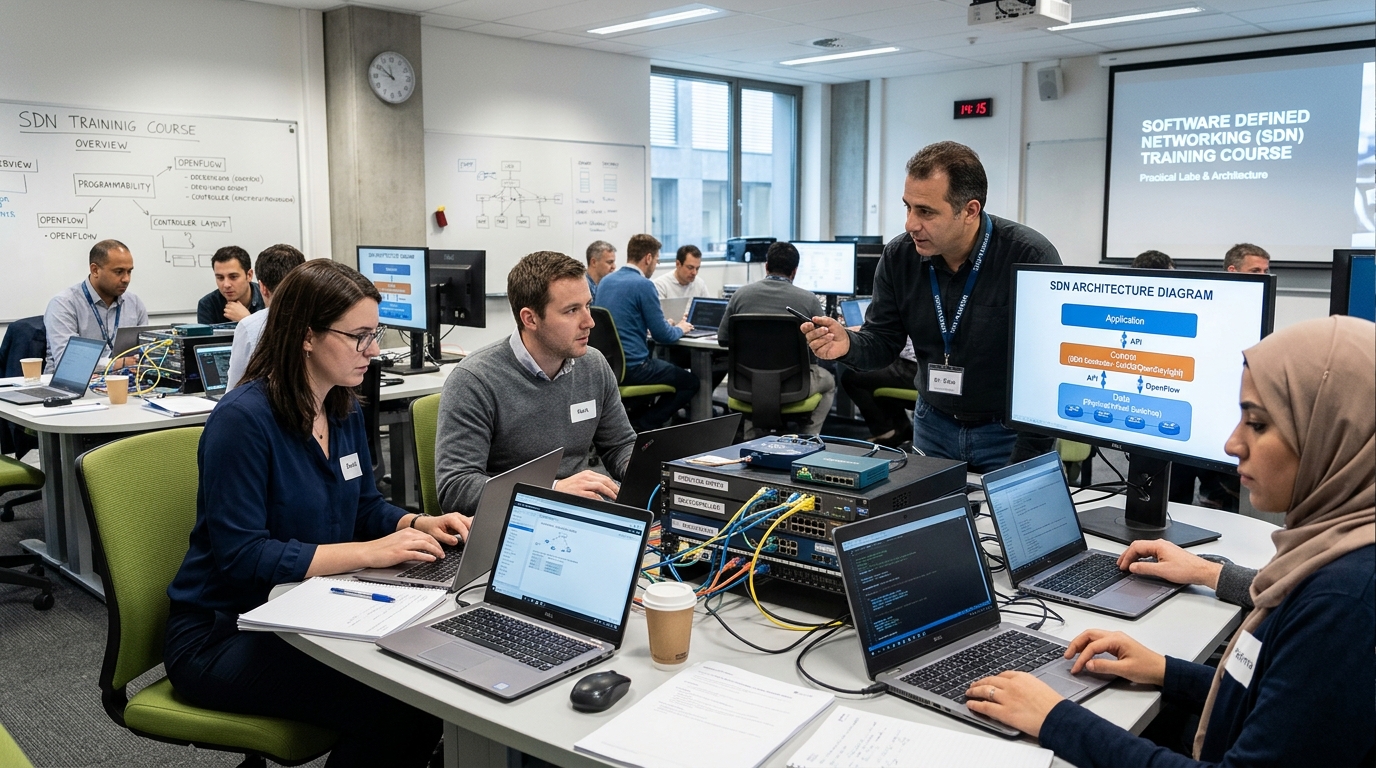
The course explores SDN controller architecture and its role in coordinating network devices, managing traffic flows, enforcing policies, and maintaining consistent network behaviour. Participants gain an understanding of how centralised controllers communicate with network infrastructure and how application programming interfaces support interaction between business applications and network resources. Particular attention is given to the relationship between the application, control, and infrastructure layers, which form the foundation of Software-Defined Networking architecture.
Another important area of the programme is network function virtualisation, which enables organisations to deliver network services through software rather than relying exclusively on dedicated hardware appliances. The relationship between SDN and network function virtualisation supports more flexible infrastructure deployment, efficient resource utilisation, and simplified service management. These technologies contribute to modern network transformation strategies, particularly in telecommunications, cloud environments, and enterprise infrastructure.
The programme also examines OpenFlow protocols and their contribution to communication between SDN controllers and forwarding devices. Understanding flow tables, forwarding instructions, communication channels, and traffic management mechanisms provides a foundation for evaluating software-controlled network environments. The course considers how programmable networks support automation, dynamic traffic management, network segmentation, and improved infrastructure visibility.
The Geneva Institute of Business Management delivers this programme under the Information & Communication Technology category, with a corporate focus on technology management, infrastructure performance, and digital transformation. It addresses the operational requirements of organisations seeking to modernise their networking environments while maintaining security, reliability, and business continuity.
By examining architecture, management frameworks, virtualisation, automation, and implementation considerations, the Software-Defined Networking SDN Training Course provides organisations with a structured understanding of how software-driven networking can support enterprise technology strategies. The programme connects technical networking capabilities with organisational objectives, enabling more informed decisions regarding infrastructure investment, network governance, operational planning, and technology integration.
Objectives
The Software-Defined Networking SDN Training Course aims to develop organisational understanding of software-controlled network infrastructure and its contribution to modern enterprise connectivity. The programme establishes a practical framework for evaluating SDN architecture, managing network resources, and aligning programmable networking capabilities with organisational technology requirements.
The primary objectives include:
-
Establishing a comprehensive understanding of Software-Defined Networking principles and their role in modern network infrastructure management.
-
Examining the architectural differences between traditional networking models and software-defined network environments.
-
Developing an understanding of SDN controller architecture and the responsibilities of centralised network control systems.
-
Analysing the relationship between application, control, and infrastructure layers within software-defined environments.
-
Exploring how OpenFlow protocols facilitate communication between network controllers and forwarding devices.
-
Understanding the operational relationship between Software-Defined Networking and network function virtualisation.
-
Examining programmable networks and their contribution to automated network configuration, resource allocation, and traffic management.
-
Strengthening organisational capabilities in network monitoring, performance evaluation, and infrastructure visibility.
-
Identifying opportunities to improve network scalability, flexibility, and operational efficiency through software-based management.
-
Evaluating SDN integration requirements within existing enterprise networking environments.
-
Understanding network automation strategies that reduce manual configuration activities and operational complexity.
-
Examining network segmentation and policy-based management approaches for improving infrastructure governance.
-
Identifying cybersecurity considerations associated with centralised network control and programmable infrastructure.
-
Assessing the role of SDN in cloud computing, data centre networking, telecommunications, and hybrid infrastructure.
-
Developing strategic approaches to SDN adoption, infrastructure modernisation, and technology investment planning.
-
Strengthening organisational decision-making concerning network architecture, interoperability, resilience, and long-term infrastructure development.
The programme also aims to establish a business-oriented perspective on software-defined infrastructure. It connects networking technology with organisational priorities such as service availability, operational continuity, resource optimisation, security governance, and digital transformation.
Through these objectives, the Geneva Institute of Business Management supports organisations in understanding how Software-Defined Networking can contribute to more adaptable, manageable, and scalable technology environments.
Target Audience
The Software-Defined Networking SDN Training Course is intended for professionals and organisations responsible for managing, developing, securing, and modernising network infrastructure. It addresses the requirements of technical specialists, IT managers, telecommunications professionals, infrastructure architects, and business leaders involved in enterprise technology operations.
The programme is particularly relevant to organisations transitioning from traditional network infrastructure towards software-controlled and automated networking environments.
IT Managers and Technology Directors
IT managers and technology directors responsible for enterprise infrastructure can use the programme to evaluate SDN adoption opportunities, understand centralised network management, and align networking strategies with organisational objectives. The course addresses infrastructure modernisation, resource management, technology investment, and operational governance.
Network Engineers and Network Administrators
Network engineers and administrators responsible for configuring and maintaining enterprise networks can strengthen their understanding of SDN architecture, controller-based management, programmable networks, and traffic flow control. The programme examines how software-defined approaches influence network configuration, monitoring, and operational administration.
Network Architects and Infrastructure Specialists
Network architects and infrastructure specialists involved in designing enterprise connectivity solutions can explore the structural components of software-defined environments. The programme covers SDN controller architecture, network interfaces, virtualised services, infrastructure integration, and scalable network design.
Telecommunications Professionals
Telecommunications professionals responsible for network services, infrastructure planning, and connectivity management can examine the role of Software-Defined Networking in modern telecommunications environments. The programme addresses network automation, virtualisation, traffic engineering, and the integration of software-controlled infrastructure.
Cloud Computing and Data Centre Professionals
Professionals managing cloud platforms, virtual infrastructure, and data centre operations can examine how programmable networks support dynamic resource allocation, network segmentation, and centralised infrastructure management. The programme also addresses the relationship between SDN and network function virtualisation.
Cybersecurity and Network Security Professionals
Cybersecurity specialists and network security personnel can explore security considerations associated with programmable network environments. Topics include access control, network segmentation, policy enforcement, controller security, traffic monitoring, and infrastructure resilience.
IT Consultants and Technology Advisors
Technology consultants responsible for infrastructure assessments, network transformation projects, and technology recommendations can strengthen their understanding of SDN capabilities. The programme supports informed evaluations of implementation requirements, operational benefits, and integration considerations.
Systems Engineers and Infrastructure Operations Teams
Systems engineers and infrastructure operations teams involved in maintaining enterprise technology environments can examine the relationship between software-defined networking, infrastructure automation, virtualisation, and service availability.
Senior Technical Managers and Business Decision-Makers
Senior managers involved in digital transformation, technology procurement, and infrastructure investment can develop a broader understanding of SDN applications and their organisational implications. The programme supports strategic discussions concerning scalability, operational efficiency, network resilience, and technology modernisation.
Organisations Planning Network Transformation
The programme is also suitable for organisations seeking to replace rigid networking arrangements with more flexible, software-controlled infrastructure. It provides a structured perspective on the technical and management considerations associated with adopting Software-Defined Networking.
Modules
Module 1: Foundations of Software-Defined Networking
This module introduces the organisational and technical foundations of Software-Defined Networking. It examines the evolution of enterprise networking and the operational limitations associated with traditional hardware-dependent infrastructure.
Key areas include:
-
Fundamentals and operating principles of Software-Defined Networking.
-
Evolution of traditional networking towards software-controlled infrastructure.
-
Differences between conventional and software-defined network architectures.
-
Separation of network control and data forwarding functions.
-
Centralised versus distributed network management.
-
Core components and operational characteristics of SDN environments.
-
Business applications of software-defined networking.
-
Organisational requirements for network infrastructure modernisation.
Module 2: SDN Architecture and Infrastructure Components
This module examines the architectural structure of software-defined network environments and the interaction between their principal components. It focuses on how different network layers coordinate infrastructure resources and support centralised management.
Key areas include:
-
Overview of SDN architectural frameworks.
-
Application layer, control layer, and infrastructure layer.
-
Communication between network applications and controllers.
-
Southbound and northbound interfaces.
-
Network abstraction and resource management.
-
Controller-to-device communication mechanisms.
-
Hardware and software components within SDN infrastructure.
-
Interoperability between SDN components and existing network systems.
Module 3: SDN Controller Architecture and Management
This module focuses on SDN controller architecture and its importance in managing software-defined network environments. It examines how controllers coordinate network devices, establish forwarding policies, and maintain centralised control over infrastructure operations.
Key areas include:
-
Functions and responsibilities of SDN controllers.
-
Centralised network control and management.
-
Controller architecture and internal components.
-
Communication between controllers and forwarding devices.
-
Network topology discovery and infrastructure visibility.
-
Flow management and policy distribution.
-
Controller scalability and availability.
-
Distributed controller environments.
-
Controller security and access management.
-
Network orchestration and management integration.
Module 4: OpenFlow Protocols and Network Communication
This module examines OpenFlow protocols as an important communication mechanism within software-defined networking environments. It considers how controllers interact with compatible network devices to manage traffic forwarding and implement network policies.
Key areas include:
-
Introduction to OpenFlow and its architectural role.
-
OpenFlow switch architecture and operational functions.
-
Flow tables and flow entry management.
-
Match fields, actions, and forwarding instructions.
-
Communication between OpenFlow controllers and switches.
-
OpenFlow channels and messaging mechanisms.
-
Packet forwarding and traffic flow management.
-
OpenFlow-based network configuration.
-
Protocol compatibility and interoperability considerations.
-
Operational limitations and implementation requirements.
Module 5: Programmable Networks and Network Automation
This module explores programmable networks and their contribution to modern infrastructure management. It examines how software-based control enables organisations to automate network operations, establish consistent policies, and improve infrastructure responsiveness.
Key areas include:
-
Principles and architecture of programmable networks.
-
Software-based network configuration and management.
-
Network automation and orchestration frameworks.
-
Application programming interfaces in network management.
-
Automated traffic routing and policy enforcement.
-
Dynamic network resource allocation.
-
Network provisioning and configuration management.
-
Infrastructure monitoring and automated responses.
-
Integration with enterprise management platforms.
-
Operational efficiency through programmable infrastructure.
Module 6: Network Function Virtualisation and SDN Integration
This module examines network function virtualisation and its relationship with Software-Defined Networking. It focuses on how organisations can deliver network services through virtualised software functions and coordinate these services through programmable infrastructure.
Key areas include:
-
Fundamentals of network function virtualisation.
-
Virtual network functions and service delivery.
-
Differences between physical and virtual network appliances.
-
Relationship between SDN and network function virtualisation.
-
Virtualised infrastructure and resource allocation.
-
Service chaining and network service orchestration.
-
Virtual switches and software-based routing.
-
Integration of SDN with cloud infrastructure.
-
Telecommunications applications of virtualised networking.
-
Infrastructure flexibility and operational optimisation.
Module 7: Network Traffic Management and Performance Optimisation
This module addresses the management of network traffic within software-defined environments. It examines how centralised control and programmable infrastructure support traffic visibility, routing decisions, performance management, and efficient resource utilisation.
Key areas include:
-
Network traffic monitoring and analysis.
-
Flow-based traffic management.
-
Intelligent routing and forwarding policies.
-
Bandwidth allocation and resource optimisation.
-
Quality of Service management.
-
Congestion monitoring and control.
-
Network load balancing.
-
Traffic prioritisation and policy enforcement.
-
Network performance indicators and reporting.
-
Infrastructure capacity planning.
Module 8: SDN Security and Network Governance
This module focuses on the security and governance requirements of software-defined networking. It examines how organisations can protect centralised control systems, manage access to network resources, and maintain secure communication across programmable infrastructure.
Key areas include:
-
Security architecture for software-defined networks.
-
SDN controller protection and access governance.
-
Authentication and authorisation mechanisms.
-
Network segmentation and isolation.
-
Policy-based security management.
-
Monitoring network activity and suspicious traffic.
-
Secure communication between infrastructure components.
-
Vulnerability management and infrastructure resilience.
-
Risk assessment for programmable networks.
-
Security governance and operational continuity.
Module 9: SDN Deployment and Enterprise Infrastructure Integration
This module examines the organisational and technical requirements associated with deploying Software-Defined Networking within enterprise environments. It considers infrastructure compatibility, migration planning, operational dependencies, and integration with existing technology systems.
Key areas include:
-
Enterprise SDN deployment strategies.
-
Assessment of existing network infrastructure.
-
Infrastructure readiness and compatibility evaluation.
-
Network migration planning.
-
Integration with traditional networking equipment.
-
SDN deployment models and architectural considerations.
-
Configuration management and operational coordination.
-
Service continuity during infrastructure transformation.
-
Implementation risks and performance considerations.
-
Enterprise network modernisation strategies.
Module 10: SDN Applications in Cloud Computing and Data Centres
This module examines the application of software-defined networking across cloud computing platforms, virtualised environments, and enterprise data centres. It focuses on the management of complex infrastructure through programmable control and centralised network visibility.
Key areas include:
-
SDN applications in enterprise data centres.
-
Cloud networking and software-controlled connectivity.
-
Virtual network provisioning.
-
Multi-tenant network environments.
-
Network segmentation in cloud infrastructure.
-
Software-defined data centre architecture.
-
Hybrid cloud networking considerations.
-
Resource allocation and infrastructure scalability.
-
Network automation in cloud environments.
-
Integration with enterprise virtualisation platforms.
Module 11: Telecommunications and Advanced Networking Applications
This module explores the role of Software-Defined Networking in telecommunications infrastructure and advanced connectivity environments. It examines how programmable network technologies support service management, infrastructure flexibility, and changing telecommunications requirements.
Key areas include:
-
SDN applications in telecommunications networks.
-
Software-controlled service provisioning.
-
Network virtualisation in telecommunications.
-
Traffic engineering and service optimisation.
-
Programmable infrastructure for evolving connectivity requirements.
-
SDN integration with next-generation network architectures.
-
Network slicing concepts and resource management.
-
Service orchestration and infrastructure coordination.
-
Operational scalability and telecommunications transformation.
-
Strategic applications of SDN in service provider environments.
Module 12: SDN Strategy, Governance, and Future Infrastructure Development
The final module focuses on the strategic management of Software-Defined Networking and its contribution to organisational technology development. It examines how businesses can evaluate SDN investments, establish governance frameworks, and develop sustainable infrastructure modernisation strategies.
Key areas include:
-
Strategic assessment of SDN adoption.
-
Business requirements and infrastructure planning.
-
Cost management and resource optimisation.
-
Technology investment evaluation.
-
Network governance and operational responsibilities.
-
Infrastructure scalability and long-term development.
-
SDN integration with emerging networking technologies.
-
Performance measurement and continuous improvement.
-
Organisational change management during network transformation.
-
Developing an enterprise Software-Defined Networking roadmap.
FAQs
1. What is Software-Defined Networking and how does it work?
Software-Defined Networking is a networking architecture that separates the control plane from the data plane, allowing network management through software-based controllers. It enables centralised control, programmable network configurations, automated traffic management, and more flexible infrastructure operations.
2. What is the role of SDN controller architecture in network management?
SDN controller architecture provides centralised control over network devices and forwarding operations. It coordinates communication between network applications and infrastructure, manages traffic policies, maintains network visibility, and supports automated configuration across software-defined environments.
3. How do OpenFlow protocols support Software-Defined Networking?
OpenFlow protocols enable communication between SDN controllers and compatible network switches. They allow controllers to manage flow tables, define packet-forwarding instructions, and implement traffic management policies across programmable network infrastructure.
4. What is the relationship between SDN and network function virtualisation?
Software-Defined Networking and network function virtualisation are complementary technologies. SDN provides programmable network control, while network function virtualisation delivers network services through software-based functions instead of dedicated hardware appliances. Their integration supports flexible infrastructure management and service deployment.
5. Who should attend the Software-Defined Networking SDN Training Course?
The course is suitable for network engineers, IT managers, network architects, telecommunications specialists, cybersecurity professionals, cloud infrastructure teams, and technology consultants. It also supports senior decision-makers responsible for enterprise networking strategies and digital infrastructure transformation.
Venues and dates
This programme runs every month in the following cities. Select a venue to register.
 Geneva
Switzerland
 Zurich
Switzerland
Basel
Switzerland
 London
UK
 Manchester
UK
 Oxford
UK
 Madrid
Spain
 Barcelona
Spain
 Paris
France
 Rome
Italy
 Vienna
Austria
Oslo
Norway
 Athens
Greece
 Copenhagen
Denmark
 Berlin
Germany
 Munich
Germany
 New York
USA
 Washington
USA
 Dubai
UAE
 Istanbul
Turkey
 Amsterdam
Netherlands
 Brussels
Belgium
 Lisbon
Portugal
 Malaga
Spain
 Milan
Italy
 Dusseldorf
Germany
 Prague
Czech Republic
 Budapest
Hungary
 Stockholm
Sweden
 Sheffield
UK
 Bangor
UK
 Ankara
Turkey
 Abu Dhabi
UAE
 Doha
Qatar
 Riyadh
Saudi Arabia
 Jeddah
Saudi Arabia
 Dammam
Saudi Arabia
 Muscat
Oman
 Amman
Jordan
 Cairo
Egypt
 Sharm El Sheikh
Egypt
 Casablanca
Morocco
 Marrakesh
Morocco
 Agadir
Morocco
 Tangier
Morocco
 Tunis
Tunisia
 Kuala Lumpur
Malaysia
 Singapore
 Jakarta
Indonesia
 Phuket
Thailand
 Tokyo
Japan
 Beijing
China
 Los Angeles
USA
 California
USA
 Toronto
Canada