Summary
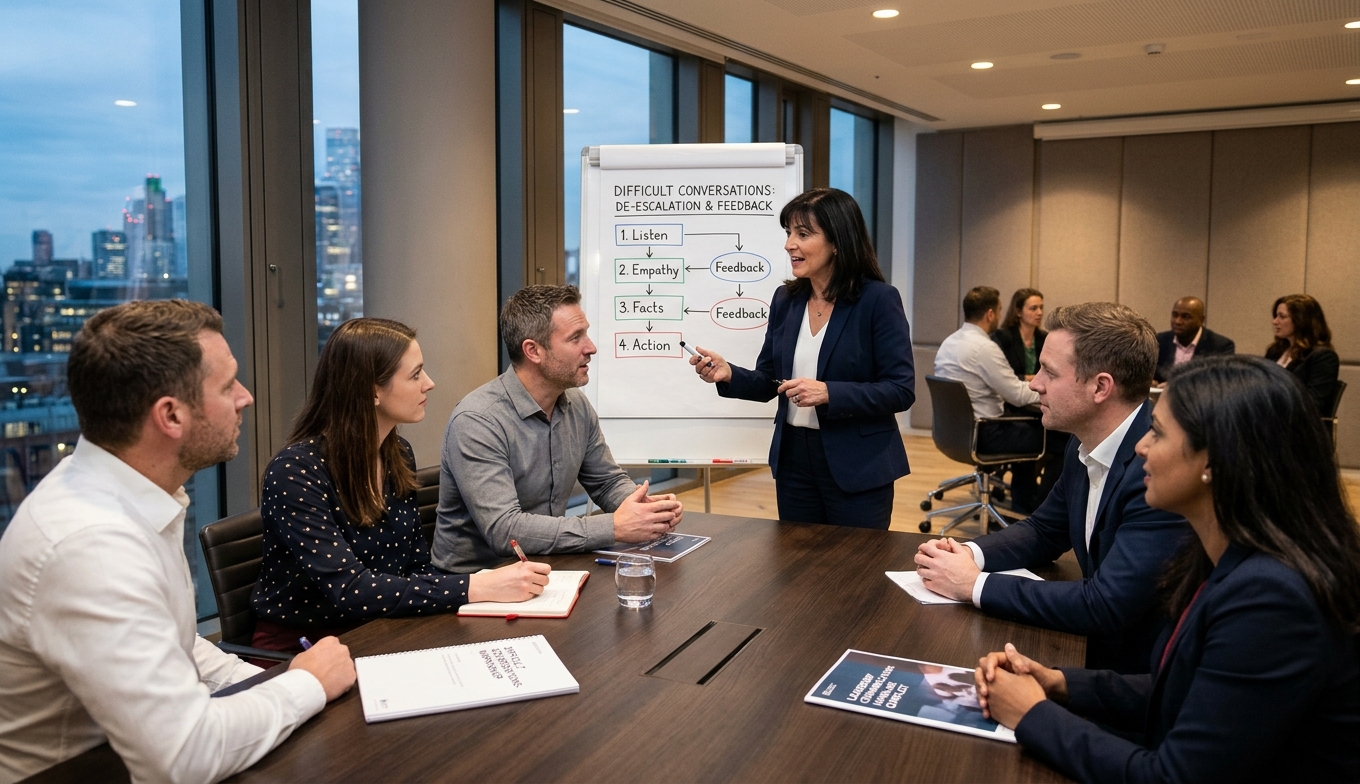
Difficult Conversations for Leaders and Managers Training Courses offered by the Geneva Institute of Business Management are designed to strengthen the ability of organisational leaders, senior managers and business professionals to manage challenging workplace discussions with confidence, clarity and professionalism. In modern corporate environments, difficult conversations are an essential part of leadership communication. Managers regularly face situations involving employee performance, workplace conflict, behavioural concerns, missed expectations, accountability, organisational changes and disagreements between colleagues. Handling these situations requires more than strong communication skills. It demands emotional intelligence, sound judgement, professional maturity and the ability to maintain constructive workplace relationships while addressing sensitive matters directly.
The programme focuses on developing practical approaches to difficult conversations that support organisational performance, employee development and effective management. It enables leaders to address uncomfortable issues without allowing misunderstandings, unresolved disagreements or communication gaps to affect team productivity. Participants gain a structured understanding of how to prepare for challenging conversations, communicate expectations, deliver constructive feedback and manage emotional responses in high-pressure situations.
Effective leadership depends on the ability to communicate clearly when circumstances are uncomfortable. Avoiding difficult discussions can create uncertainty, reduce employee confidence, weaken accountability and allow workplace problems to become more complicated. Conversely, addressing concerns professionally helps establish transparency, reinforce organisational standards and create a culture where employees understand their responsibilities. These training courses emphasise the importance of balancing direct communication with respect, fairness and professional sensitivity.
A central component of the programme is leadership communication during complex interpersonal situations. Managers must communicate decisions, explain performance concerns, challenge inappropriate behaviour and address disagreements without damaging professional relationships. The ability to distinguish between personal reactions and business objectives is particularly important when conversations involve sensitive subjects. Leaders must remain focused on facts, organisational expectations and practical outcomes rather than allowing discussions to become confrontational.
The programme also addresses the relationship between difficult conversations and workplace accountability. Effective managers understand that accountability requires consistent communication, clearly defined expectations and timely intervention when responsibilities are not fulfilled. By addressing performance gaps and behavioural concerns constructively, leaders can encourage ownership, improve professional standards and support continuous improvement across departments.
Another important area is conflict management. Workplace disagreements can arise from competing priorities, communication failures, differences in working styles, unclear responsibilities or organisational pressures. Leaders need the ability to recognise underlying concerns, manage opposing perspectives and guide discussions towards workable solutions. The programme develops approaches that help managers prevent unnecessary escalation while maintaining appropriate professional boundaries.
Through the Geneva Institute of Business Management, Difficult Conversations for Leaders and Managers Training Courses provide a corporate-focused framework for strengthening workplace dialogue, improving management effectiveness and building stronger professional relationships. The programme supports organisations seeking leaders who can address complex issues, communicate difficult decisions and maintain constructive working environments.
By integrating feedback, conflict resolution, accountability and emotional intelligence into everyday leadership practices, the training helps organisations establish more transparent communication processes. It positions difficult conversations as an essential management responsibility that contributes to stronger teams, improved employee engagement and sustainable organisational performance.
Objectives
The primary objective of Difficult Conversations for Leaders and Managers Training Courses is to strengthen leadership capabilities in managing sensitive workplace discussions and achieving constructive business outcomes. The programme focuses on practical communication strategies that help managers address challenging situations while maintaining professional relationships and organisational standards.
Strengthen Leadership Communication
Develop the ability to communicate sensitive information clearly, confidently and professionally. Leaders strengthen their approach to discussing performance concerns, organisational expectations, behavioural issues and management decisions. The objective is to ensure that important messages are communicated accurately without creating unnecessary tension or confusion.
Improve Confidence in Difficult Conversations
Enable managers to approach uncomfortable discussions with greater confidence and preparation. Participants develop the ability to identify the purpose of a conversation, establish relevant facts, anticipate potential reactions and maintain control of the discussion. This supports timely intervention instead of allowing difficult situations to remain unresolved.
Develop Constructive Feedback Practices
Strengthen the ability to deliver feedback that encourages improvement and professional accountability. Managers learn to communicate performance gaps, recognise achievements and explain required changes using clear examples and objective expectations. The focus is on making feedback specific, relevant and aligned with organisational objectives.
Manage Workplace Conflict Effectively
Improve the ability to recognise conflict triggers, understand different perspectives and manage disagreements constructively. Leaders develop approaches for addressing interpersonal tensions, resolving misunderstandings and preventing workplace disputes from affecting team performance.
Promote Accountability and Ownership
Establish stronger approaches to communicating responsibilities, performance expectations and individual commitments. Managers learn how to address missed deadlines, repeated mistakes and inconsistent performance while encouraging employees to take ownership of their decisions and actions.
Strengthen Emotional Intelligence
Develop greater awareness of emotional responses during challenging conversations. Leaders improve their ability to recognise frustration, defensiveness and resistance while maintaining composure and professional judgement. Emotional intelligence supports productive discussions, particularly when sensitive issues create pressure.
Improve Workplace Dialogue
Encourage transparent, respectful and solution-focused communication across organisational levels. The programme strengthens managers' ability to listen actively, ask relevant questions and create opportunities for employees to express concerns without losing sight of business priorities.
Address Performance and Behavioural Concerns
Improve management approaches for discussing underperformance, inappropriate conduct, communication problems and unmet professional standards. Leaders develop the ability to address these matters fairly, consistently and in accordance with organisational policies.
Support Organisational Change
Strengthen the ability to communicate difficult organisational decisions, structural changes and shifting business priorities. Managers learn how to explain the reasons behind decisions, acknowledge employee concerns and maintain clarity during periods of uncertainty.
Build Trust Through Professional Communication
Promote stronger workplace relationships by combining honesty, consistency and respect. Leaders develop communication practices that reinforce credibility and demonstrate that difficult subjects can be addressed without compromising professional dignity.
Target Audience
Difficult Conversations for Leaders and Managers Training Courses are designed for professionals responsible for managing people, addressing workplace challenges, communicating organisational expectations and maintaining productive working relationships. The programme is relevant to organisations seeking stronger leadership communication, effective conflict management and improved accountability across management structures.
Senior Executives and Business Leaders
Senior executives responsible for organisational performance, strategic direction and leadership culture benefit from developing stronger approaches to sensitive business discussions. They frequently communicate difficult decisions, address leadership disagreements and manage complex stakeholder relationships. The programme strengthens their ability to maintain transparency while protecting organisational priorities.
Department Heads and Functional Managers
Department heads regularly address employee performance, operational problems, resource limitations and disagreements between teams. The training supports their ability to manage difficult conversations systematically, communicate expectations and maintain accountability across their departments.
Middle Managers and Team Leaders
Middle managers serve as an important connection between senior leadership and operational employees. They must communicate management decisions, address employee concerns and resolve everyday workplace disagreements. The programme strengthens their confidence in handling challenging conversations while maintaining team cooperation and performance.
Human Resources Directors and HR Managers
HR professionals frequently manage sensitive discussions involving employee grievances, behavioural concerns, performance management, workplace disputes and organisational policies. The programme helps them strengthen communication practices and support managers in handling difficult employee interactions professionally.
Learning and Development Managers
Learning and development professionals responsible for management development and organisational capability can benefit from understanding the communication behaviours required for effective leadership. The training supports their efforts to strengthen managerial confidence, feedback practices and workplace dialogue.
Employee Relations and Industrial Relations Professionals
Professionals responsible for employee relations regularly deal with sensitive workplace matters and conflicting perspectives. The programme develops approaches for facilitating constructive discussions, managing concerns and supporting fair communication between employees and management.
Project Managers and Programme Directors
Project managers often encounter disagreements concerning responsibilities, deadlines, resource allocation and project expectations. The training helps them address performance issues, manage stakeholder concerns and communicate difficult messages without disrupting project progress.
Operations and General Managers
Operations and general managers responsible for business continuity and departmental efficiency need to address operational failures, employee performance gaps and inconsistent working practices. The programme strengthens their ability to communicate corrective actions and establish clear accountability.
Emerging Leaders and Newly Appointed Managers
Professionals transitioning into leadership positions must develop the confidence to manage conversations that were previously handled by senior colleagues. The programme provides practical management approaches for discussing expectations, delivering feedback and addressing interpersonal challenges.
Consultants and Organisational Development Professionals
Consultants and organisational development specialists involved in leadership effectiveness, workplace culture and management improvement can strengthen their understanding of difficult conversations. The programme supports their ability to advise organisations on communication practices and constructive conflict management.
Modules
The Difficult Conversations for Leaders and Managers Training Courses are structured around essential management responsibilities and practical workplace situations. Each module addresses a specific aspect of leadership communication, enabling participants to develop a consistent approach to challenging conversations across different organisational environments.
Module 1: Understanding Difficult Conversations in Leadership
-
The role of difficult conversations in effective management.
-
Common situations that require challenging workplace discussions.
-
Organisational consequences of avoiding sensitive conversations.
-
The relationship between communication and leadership credibility.
-
Identifying the difference between constructive disagreement and workplace conflict.
-
Recognising communication barriers that prevent timely intervention.
-
Understanding how difficult conversations influence employee relationships and performance.
Module 2: Leadership Communication and Professional Preparation
-
Establishing clear objectives before initiating difficult conversations.
-
Identifying relevant facts and separating assumptions from evidence.
-
Selecting appropriate communication methods and discussion settings.
-
Preparing messages for sensitive employee and management issues.
-
Establishing a professional tone during challenging discussions.
-
Structuring conversations around business priorities and expected outcomes.
-
Maintaining consistency between leadership decisions and communication.
Module 3: Emotional Intelligence During Challenging Conversations
-
Understanding emotional intelligence in leadership communication.
-
Recognising personal emotional triggers and behavioural responses.
-
Managing frustration, disappointment and workplace pressure.
-
Identifying defensive behaviour and emotional resistance.
-
Maintaining composure during disagreements and criticism.
-
Demonstrating empathy without compromising management standards.
-
Using self-awareness to improve professional judgement.
Module 4: Delivering Constructive Feedback and Performance Messages
-
Communicating positive and corrective feedback effectively.
-
Addressing performance gaps through objective discussion.
-
Explaining expectations using measurable performance indicators.
-
Discussing repeated mistakes and missed deadlines.
-
Recognising employee contributions while addressing improvement areas.
-
Managing negative reactions to performance feedback.
-
Establishing follow-up actions and measurable improvement commitments.
-
Connecting individual performance with organisational objectives.
Module 5: Managing Workplace Conflict and Disagreements
-
Identifying common causes of workplace conflict.
-
Understanding interpersonal and departmental disagreements.
-
Addressing misunderstandings before they escalate.
-
Managing competing priorities and conflicting viewpoints.
-
Encouraging constructive discussion between opposing parties.
-
Maintaining neutrality during sensitive workplace disputes.
-
Developing practical approaches to conflict resolution.
-
Establishing agreements that support continued collaboration.
Module 6: Accountability and Difficult Performance Conversations
-
Establishing clear standards of individual accountability.
-
Addressing missed responsibilities and incomplete work.
-
Communicating the consequences of repeated performance issues.
-
Discussing ownership, responsibility and professional conduct.
-
Managing resistance to accountability discussions.
-
Setting clear expectations for corrective action.
-
Monitoring commitments and evaluating progress.
-
Creating consistent accountability practices across teams.
Module 7: Handling Defensive Reactions and Resistance
-
Recognising common defensive communication patterns.
-
Managing disagreement without becoming confrontational.
-
Responding to denial, excuses and emotional reactions.
-
Addressing employees who avoid responsibility.
-
Maintaining control of conversations when tensions increase.
-
Using questioning techniques to clarify concerns.
-
Redirecting unproductive discussions towards practical solutions.
-
Establishing professional boundaries during difficult interactions.
Module 8: Active Listening and Effective Workplace Dialogue
-
Understanding the importance of active listening in leadership.
-
Asking open and relevant questions during sensitive discussions.
-
Recognising verbal and non-verbal communication signals.
-
Understanding employee concerns and underlying perspectives.
-
Avoiding interruptions and premature conclusions.
-
Clarifying misunderstandings through effective questioning.
-
Encouraging honest communication and professional participation.
-
Summarising discussion points to establish mutual understanding.
Module 9: Communicating Difficult Decisions and Organisational Changes
-
Explaining unpopular management decisions professionally.
-
Communicating organisational restructuring and changing responsibilities.
-
Addressing employee concerns about uncertainty and change.
-
Managing sensitive discussions involving operational adjustments.
-
Communicating business constraints and competing priorities.
-
Maintaining transparency while protecting confidential information.
-
Supporting employee understanding during organisational transitions.
-
Reinforcing leadership credibility through consistent communication.
Module 10: Managing Sensitive Employee and Behavioural Issues
-
Addressing inappropriate workplace behaviour.
-
Discussing communication failures and professional misconduct.
-
Handling interpersonal complaints and employee concerns.
-
Managing conversations involving repeated policy violations.
-
Maintaining confidentiality and professional discretion.
-
Communicating organisational standards and behavioural expectations.
-
Understanding the importance of fairness and consistency.
-
Working within organisational procedures and relevant HR policies.
Module 11: Negotiation, Persuasion and Finding Common Ground
-
Applying negotiation techniques to challenging workplace discussions.
-
Identifying shared interests and areas of disagreement.
-
Understanding different stakeholder expectations.
-
Communicating management positions with clarity and confidence.
-
Balancing organisational priorities with employee concerns.
-
Developing mutually acceptable solutions where appropriate.
-
Managing competing expectations without damaging relationships.
-
Reaching practical agreements that support business objectives.
Module 12: Maintaining Professional Relationships After Difficult Conversations
-
Rebuilding trust following challenging discussions.
-
Maintaining professional communication after disagreements.
-
Following up on agreed actions and responsibilities.
-
Monitoring behavioural and performance improvements.
-
Preventing recurring communication problems.
-
Supporting constructive relationships between managers and employees.
-
Maintaining consistency in leadership expectations.
-
Turning difficult discussions into opportunities for organisational improvement.
Module 13: Building a Culture of Open Communication and Accountability
-
Establishing transparent workplace communication standards.
-
Encouraging employees to raise concerns constructively.
-
Integrating feedback into everyday management practices.
-
Promoting accountability across organisational levels.
-
Strengthening trust between employees and leadership.
-
Encouraging early resolution of workplace disagreements.
-
Aligning management communication with organisational values.
-
Developing sustainable practices for effective workplace dialogue.
Module 14: Practical Application and Leadership Communication Scenarios
-
Applying difficult conversation frameworks to realistic management situations.
-
Addressing employee underperformance through structured discussions.
-
Managing disagreements between colleagues and departments.
-
Delivering corrective feedback in sensitive circumstances.
-
Communicating unpopular decisions to employees and stakeholders.
-
Handling resistance during accountability discussions.
-
Evaluating communication approaches and their organisational impact.
-
Developing practical action plans for improving leadership communication.
FAQs
1. What are Difficult Conversations for Leaders and Managers Training Courses?
Difficult Conversations for Leaders and Managers Training Courses focus on developing the communication skills required to address sensitive workplace issues professionally. They cover challenging conversations involving employee performance, feedback, workplace conflict, accountability, behavioural concerns and organisational changes.
2. Why are difficult conversations important for effective leadership?
Difficult conversations help leaders address problems before they affect employee relationships, team performance and organisational productivity. They promote transparency, establish clear expectations, strengthen accountability and support a workplace culture based on professional communication.
3. How can managers handle difficult conversations with employees?
Managers can handle difficult conversations by preparing relevant facts, defining the purpose of the discussion, listening actively and communicating concerns clearly. Maintaining emotional control, demonstrating respect and agreeing on practical next steps also help achieve constructive outcomes.
4. How does this training improve workplace conflict management?
The training develops practical approaches for identifying conflict triggers, understanding different perspectives and managing disagreements professionally. It strengthens leadership communication, active listening and problem-solving capabilities to help managers resolve workplace issues and maintain productive professional relationships.
5. Who should attend Difficult Conversations for Leaders and Managers Training Courses?
These courses are suitable for senior executives, department heads, team leaders, middle managers, HR professionals, project managers and emerging leaders. They are particularly relevant to professionals responsible for employee performance, workplace relationships, feedback, accountability and organisational communication.
Venues and dates
This programme runs every month in the following cities. Select a venue to register.
 Geneva
Switzerland
 Zurich
Switzerland
Basel
Switzerland
 London
UK
 Manchester
UK
 Oxford
UK
 Madrid
Spain
 Barcelona
Spain
 Paris
France
 Rome
Italy
 Vienna
Austria
Oslo
Norway
 Athens
Greece
 Copenhagen
Denmark
 Berlin
Germany
 Munich
Germany
 New York
USA
 Washington
USA
 Dubai
UAE
 Istanbul
Turkey
 Amsterdam
Netherlands
 Brussels
Belgium
 Lisbon
Portugal
 Malaga
Spain
 Milan
Italy
 Dusseldorf
Germany
 Prague
Czech Republic
 Budapest
Hungary
 Stockholm
Sweden
 Sheffield
UK
 Bangor
UK
 Ankara
Turkey
 Abu Dhabi
UAE
 Doha
Qatar
 Riyadh
Saudi Arabia
 Jeddah
Saudi Arabia
 Dammam
Saudi Arabia
 Muscat
Oman
 Amman
Jordan
 Cairo
Egypt
 Sharm El Sheikh
Egypt
 Casablanca
Morocco
 Marrakesh
Morocco
 Agadir
Morocco
 Tangier
Morocco
 Tunis
Tunisia
 Kuala Lumpur
Malaysia
 Singapore
 Jakarta
Indonesia
 Phuket
Thailand
 Tokyo
Japan
 Beijing
China
 Los Angeles
USA
 California
USA
 Toronto
Canada