Summary
Coaching Leadership and Managerial Coaching Skills Training Courses offered by the Geneva Institute of Business Management are designed to strengthen leadership effectiveness, improve managerial capabilities, and establish a performance-driven workplace culture. Modern organisations require managers who can do more than assign responsibilities, monitor progress, and evaluate results. Effective leaders must be capable of developing people, encouraging accountability, identifying individual strengths, and helping employees achieve measurable professional growth. Coaching leadership provides a practical management approach that enables leaders to guide employees towards better decisions, stronger performance, and greater workplace independence.
These training courses focus on integrating coaching principles into everyday management responsibilities. They equip managers and organisational leaders with the communication techniques, questioning strategies, feedback methods, and practical frameworks required to conduct productive coaching conversations. Rather than relying exclusively on traditional supervisory practices, participants develop the ability to support employees through structured discussions, constructive guidance, and continuous performance improvement.
The programme explores the relationship between coaching leadership, employee development, managerial effectiveness, and organisational performance. Participants gain an understanding of how coaching-based management strengthens professional relationships, improves workplace communication, and creates opportunities for employees to take greater responsibility for their contributions. The emphasis remains on practical managerial application, ensuring that coaching becomes an integrated part of leadership responsibilities rather than an occasional management activity.
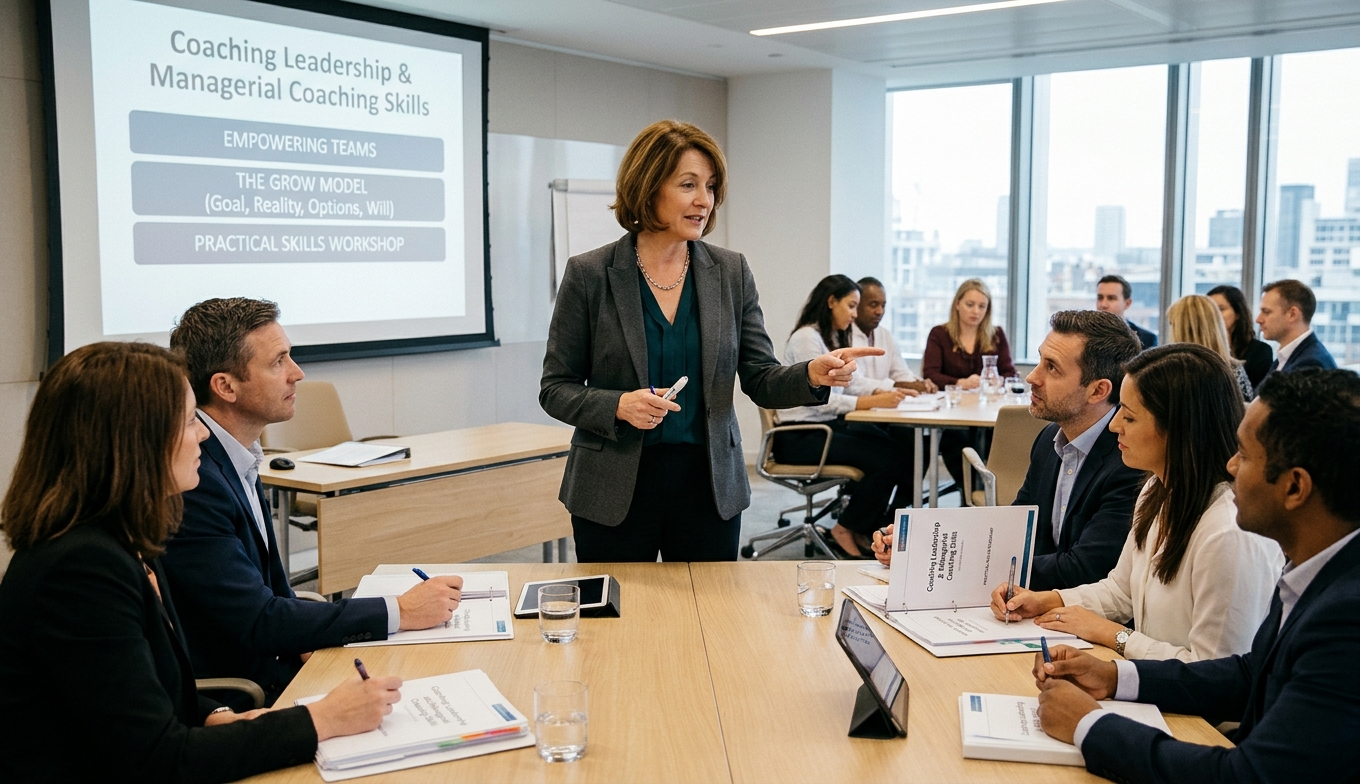
A central component of the programme is the GROW model, a recognised coaching framework that provides structure to managerial coaching conversations. Through its four stages of Goal, Reality, Options, and Will, managers learn how to establish clear objectives, examine current circumstances, identify possible solutions, and agree on actionable commitments. Applying this framework enables leaders to address workplace challenges systematically while encouraging employees to participate actively in their own development.
The training also examines how managers can adapt their coaching approaches to different employee needs, professional capabilities, performance expectations, and organisational situations. Participants explore techniques for addressing performance gaps, supporting career development, managing difficult conversations, and encouraging continuous improvement. These capabilities help managers balance operational responsibilities with their responsibility to develop capable, confident, and accountable teams.
The Geneva Institute of Business Management delivers these programmes through its Leadership and Management Training Courses category, supporting organisations that want to strengthen their management structures and improve leadership outcomes. The programme connects managerial coaching skills with strategic workforce development, effective communication, employee engagement, and sustainable organisational performance.
By developing a consistent coaching leadership approach, organisations can create management environments where employees understand expectations, receive constructive support, and take ownership of professional outcomes. The resulting improvements contribute to stronger working relationships, better decision-making, increased accountability, and more effective organisational performance.
Objectives
The Coaching Leadership and Managerial Coaching Skills Training Courses aim to strengthen the ability of managers and organisational leaders to use coaching as a practical management approach. The programme focuses on developing leadership behaviours that improve employee performance, encourage professional growth, and support organisational objectives.
Strengthen Coaching Leadership Capabilities
Develop the ability to apply coaching leadership principles across different management responsibilities. Participants learn how to move beyond directive supervision and adopt a supportive approach that encourages employee involvement, independent thinking, and accountability. The objective is to establish leadership behaviours that improve workplace relationships while maintaining clear performance expectations.
Develop Effective Managerial Coaching Skills
Strengthen the practical capabilities required to coach employees through everyday workplace situations. Participants explore how to initiate coaching discussions, identify performance concerns, ask relevant questions, provide constructive feedback, and agree on realistic improvement actions. These capabilities help managers address individual development needs while maintaining operational priorities.
Apply the GROW Model in Management Situations
Build confidence in using the GROW model to structure productive coaching conversations. Participants learn how to establish meaningful goals, assess existing performance conditions, explore alternative solutions, and convert discussions into measurable commitments. This framework supports consistent coaching practices and improves the quality of managerial interactions.
Improve Coaching Conversations and Workplace Communication
Develop communication techniques that encourage openness, professional trust, and meaningful employee participation. Participants strengthen their listening, questioning, clarification, and feedback skills. These capabilities enable managers to understand employee concerns, recognise workplace challenges, and guide discussions towards practical outcomes.
Support Employee Development and Career Progression
Improve the ability to identify individual strengths, development opportunities, and professional improvement requirements. Managers learn how to connect coaching activities with employee development objectives, helping individuals strengthen their capabilities and prepare for increased responsibilities.
Improve Employee Performance and Accountability
Establish coaching practices that connect individual responsibilities with organisational performance expectations. Participants learn how to identify performance gaps, agree on improvement measures, monitor progress, and encourage employees to take ownership of their results. The objective is to make performance management more constructive, consistent, and development-focused.
Build Confidence in Managing Difficult Conversations
Strengthen the ability to address sensitive workplace matters through professional and constructive coaching discussions. Participants explore how to communicate performance concerns, manage resistance, address misunderstandings, and maintain productive relationships during challenging conversations.
Encourage Independent Thinking and Problem-Solving
Develop managerial approaches that help employees analyse situations, evaluate available options, and identify appropriate solutions. Participants learn how to guide employees without unnecessarily taking control of every decision, supporting stronger problem-solving capabilities and greater workplace independence.
Establish a Continuous Coaching Culture
Enable managers to integrate coaching into regular performance discussions, team interactions, development planning, and management reviews. The objective is to establish consistent coaching practices that contribute to employee engagement, organisational learning, and sustainable performance improvement.
Align Managerial Coaching with Organisational Goals
Strengthen the connection between individual employee development and wider business priorities. Participants learn how to ensure that coaching objectives support departmental targets, workforce requirements, leadership expectations, and long-term organisational success.
Target Audience
The Coaching Leadership and Managerial Coaching Skills Training Courses are designed for professionals who hold management responsibilities or influence employee performance, development, and organisational effectiveness. The programme is particularly relevant to individuals who want to integrate coaching into their leadership approach and strengthen their ability to develop high-performing teams.
Senior Executives and Organisational Leaders
Senior executives and business leaders responsible for organisational direction, workforce performance, and leadership development can benefit from the programme. It supports their ability to establish coaching-based management practices across departments, develop leadership capabilities, and strengthen accountability throughout the organisation.
Department Heads and Functional Managers
Department heads and functional managers responsible for achieving departmental objectives can use coaching leadership to improve team performance and employee contribution. The programme develops their ability to identify capability gaps, guide professional development, and maintain consistent performance expectations.
Middle Managers and Supervisors
Middle managers and supervisors who manage daily operations and employee responsibilities will benefit from practical managerial coaching techniques. The programme helps them improve communication, provide constructive feedback, address performance challenges, and encourage employees to take greater ownership of their work.
Human Resources Directors and HR Managers
HR professionals responsible for employee development, performance management, talent retention, and workforce planning can strengthen their understanding of coaching-based management. The programme supports the integration of coaching practices into leadership development initiatives and employee performance improvement strategies.
Learning and Development Managers
Learning and development professionals responsible for strengthening workforce capabilities can use the programme to understand how managerial coaching supports continuous professional development. It helps them connect development initiatives with practical workplace performance and management responsibilities.
Team Leaders and Project Managers
Team leaders and project managers who coordinate employees, allocate responsibilities, and manage project outcomes can improve their ability to guide individuals through challenges. Coaching techniques help them strengthen collaboration, clarify expectations, resolve performance issues, and maintain accountability.
Business Owners and Entrepreneurs
Business owners and entrepreneurs managing growing teams can benefit from coaching leadership practices that improve employee independence and reduce excessive reliance on direct supervision. The programme supports the development of management approaches that encourage initiative, professional responsibility, and sustainable business performance.
Talent Management and Organisational Development Professionals
Professionals responsible for identifying leadership potential, managing talent development, and supporting organisational change can use coaching principles to strengthen employee capabilities. The programme provides practical insights into developing people through structured conversations and measurable improvement objectives.
Newly Appointed Managers
Professionals transitioning into managerial positions can develop essential coaching skills that support their new responsibilities. The programme introduces practical methods for communicating expectations, managing employee relationships, encouraging development, and maintaining performance standards.
Professionals Preparing for Senior Leadership Positions
Experienced professionals preparing to assume greater management responsibilities can strengthen their leadership approach through coaching-based techniques. The programme supports the transition from individual performance management towards developing others and achieving results through effective leadership.
Modules
The Coaching Leadership and Managerial Coaching Skills Training Courses cover the essential principles, frameworks, and practical management techniques required to establish effective coaching practices within organisations. Each module focuses on a specific aspect of managerial coaching and its contribution to employee development and organisational performance.
Module 1: Foundations of Coaching Leadership
-
Understanding coaching leadership and its role in modern management.
-
Differences between traditional management, mentoring, counselling, and coaching.
-
Core principles of effective coaching-based leadership.
-
The relationship between leadership behaviour and employee performance.
-
Establishing trust, professional respect, and psychological safety.
-
Balancing managerial authority with employee empowerment.
-
Integrating coaching principles into everyday management responsibilities.
-
Identifying organisational situations where coaching leadership delivers value.
Module 2: Essential Managerial Coaching Skills
-
Developing the core capabilities required for effective manager coaching.
-
Establishing productive coaching relationships with employees.
-
Using active listening to understand employee perspectives.
-
Asking open-ended, focused, and exploratory questions.
-
Recognising individual strengths and development requirements.
-
Guiding without creating unnecessary employee dependency.
-
Encouraging personal responsibility and independent decision-making.
-
Adapting coaching approaches to different professional situations.
Module 3: The GROW Model for Effective Coaching
-
Introduction to the GROW model and its application in managerial coaching.
-
Understanding Goal setting and establishing clear development objectives.
-
Exploring Reality through performance assessment and workplace analysis.
-
Identifying Options and evaluating possible solutions.
-
Establishing Will through commitments, responsibilities, and action planning.
-
Applying the GROW model during employee performance discussions.
-
Using structured coaching questions to improve discussion quality.
-
Evaluating progress and maintaining accountability after coaching sessions.
Module 4: Planning and Conducting Coaching Conversations
-
Preparing for effective and objective coaching conversations.
-
Establishing the purpose and expected outcomes of coaching discussions.
-
Creating a professional environment that encourages open communication.
-
Using questioning techniques to explore employee challenges.
-
Identifying the difference between stated concerns and underlying issues.
-
Maintaining focus during complex managerial conversations.
-
Encouraging employee participation and constructive dialogue.
-
Converting discussions into practical decisions and agreed actions.
Module 5: Active Listening and Advanced Communication Techniques
-
Developing attentive and purposeful listening behaviours.
-
Recognising verbal and non-verbal communication signals.
-
Using clarification and summarising techniques.
-
Understanding employee perspectives without making assumptions.
-
Managing communication barriers and misunderstandings.
-
Asking powerful questions that encourage reflection.
-
Communicating expectations with clarity and professionalism.
-
Building stronger relationships through consistent communication.
Module 6: Coaching for Employee Development
-
Identifying individual employee capabilities and development needs.
-
Connecting coaching activities with professional growth objectives.
-
Developing individual employee development plans.
-
Recognising strengths, competencies, and improvement opportunities.
-
Supporting career progression through structured coaching.
-
Encouraging continuous learning and workplace adaptability.
-
Preparing employees for expanded responsibilities.
-
Monitoring development progress and reviewing outcomes.
Module 7: Performance Coaching and Accountability
-
Understanding the relationship between coaching and performance management.
-
Identifying performance gaps and their underlying causes.
-
Establishing measurable employee performance objectives.
-
Delivering constructive and behaviour-focused feedback.
-
Supporting employees who experience performance difficulties.
-
Agreeing on improvement actions and realistic deadlines.
-
Monitoring progress through regular coaching discussions.
-
Strengthening employee ownership and professional accountability.
Module 8: Coaching Difficult Employees and Managing Resistance
-
Understanding the reasons behind employee resistance.
-
Recognising behavioural patterns that affect workplace performance.
-
Addressing defensive reactions during coaching discussions.
-
Managing disagreements through constructive communication.
-
Discussing sensitive performance concerns professionally.
-
Maintaining objectivity when dealing with challenging situations.
-
Encouraging cooperation and individual responsibility.
-
Establishing appropriate follow-up actions and performance expectations.
Module 9: Feedback, Motivation, and Employee Engagement
-
Understanding the role of feedback in employee development.
-
Delivering specific, timely, and constructive feedback.
-
Recognising employee contributions and professional achievements.
-
Addressing negative performance patterns without damaging relationships.
-
Using coaching to improve employee motivation.
-
Identifying factors that influence workplace engagement.
-
Encouraging employee confidence and initiative.
-
Connecting individual contributions with organisational objectives.
Module 10: Coaching Leadership for Team Performance
-
Applying coaching leadership principles to team management.
-
Establishing shared objectives and performance expectations.
-
Encouraging collaboration and collective accountability.
-
Coaching employees through team conflicts and disagreements.
-
Identifying individual contributions to team effectiveness.
-
Supporting knowledge sharing and collaborative problem-solving.
-
Developing team capabilities through continuous coaching.
-
Strengthening coordination and overall departmental performance.
Module 11: Situational Coaching and Adaptive Leadership
-
Understanding how coaching requirements differ across workplace situations.
-
Adapting coaching approaches to employee experience and capability.
-
Balancing directive guidance with supportive coaching.
-
Coaching high-performing employees for increased responsibility.
-
Supporting employees who require additional performance guidance.
-
Managing coaching discussions during organisational change.
-
Responding to different communication and behavioural preferences.
-
Selecting appropriate coaching techniques for specific management challenges.
Module 12: Measuring Coaching Effectiveness and Organisational Impact
-
Establishing indicators for evaluating coaching effectiveness.
-
Measuring improvements in employee performance and productivity.
-
Reviewing progress against individual development objectives.
-
Evaluating the effectiveness of managerial coaching conversations.
-
Gathering employee feedback on coaching experiences.
-
Identifying opportunities to improve coaching practices.
-
Connecting employee development outcomes with business performance.
-
Establishing long-term coaching strategies and continuous improvement processes.
FAQs
1. What is coaching leadership in management?
Coaching leadership is a management approach that focuses on developing employees through structured conversations, active listening, constructive feedback, and professional guidance. It enables managers to improve employee performance, encourage independent decision-making, and support continuous development.
2. How does the GROW model support managerial coaching?
The GROW model provides a structured framework for effective coaching conversations through four stages: Goal, Reality, Options, and Will. Managers use this approach to establish objectives, understand current challenges, explore solutions, and agree on measurable actions.
3. Why are coaching conversations important for employee development?
Coaching conversations help managers understand employee needs, identify performance gaps, and recognise professional development opportunities. They also encourage employees to take responsibility for their progress and contribute more effectively to organisational objectives.
4. How can managers use coaching skills to improve employee performance?
Managers can use coaching skills to establish clear expectations, provide constructive feedback, identify improvement opportunities, and agree on measurable performance objectives. Regular coaching discussions help employees address challenges, strengthen their capabilities, and maintain accountability.
5. Who should attend Coaching Leadership and Managerial Coaching Skills Training Courses?
These courses are suitable for senior executives, department heads, middle managers, supervisors, HR professionals, team leaders, project managers, and business owners. They are particularly valuable for professionals responsible for employee development, performance improvement, and organisational leadership.
Venues and dates
This programme runs every month in the following cities. Select a venue to register.
 Geneva
Switzerland
 Zurich
Switzerland
Basel
Switzerland
 London
UK
 Manchester
UK
 Oxford
UK
 Madrid
Spain
 Barcelona
Spain
 Paris
France
 Rome
Italy
 Vienna
Austria
Oslo
Norway
 Athens
Greece
 Copenhagen
Denmark
 Berlin
Germany
 Munich
Germany
 New York
USA
 Washington
USA
 Dubai
UAE
 Istanbul
Turkey
 Amsterdam
Netherlands
 Brussels
Belgium
 Lisbon
Portugal
 Malaga
Spain
 Milan
Italy
 Dusseldorf
Germany
 Prague
Czech Republic
 Budapest
Hungary
 Stockholm
Sweden
 Sheffield
UK
 Bangor
UK
 Ankara
Turkey
 Abu Dhabi
UAE
 Doha
Qatar
 Riyadh
Saudi Arabia
 Jeddah
Saudi Arabia
 Dammam
Saudi Arabia
 Muscat
Oman
 Amman
Jordan
 Cairo
Egypt
 Sharm El Sheikh
Egypt
 Casablanca
Morocco
 Marrakesh
Morocco
 Agadir
Morocco
 Tangier
Morocco
 Tunis
Tunisia
 Kuala Lumpur
Malaysia
 Singapore
 Jakarta
Indonesia
 Phuket
Thailand
 Tokyo
Japan
 Beijing
China
 Los Angeles
USA
 California
USA
 Toronto
Canada