Summary
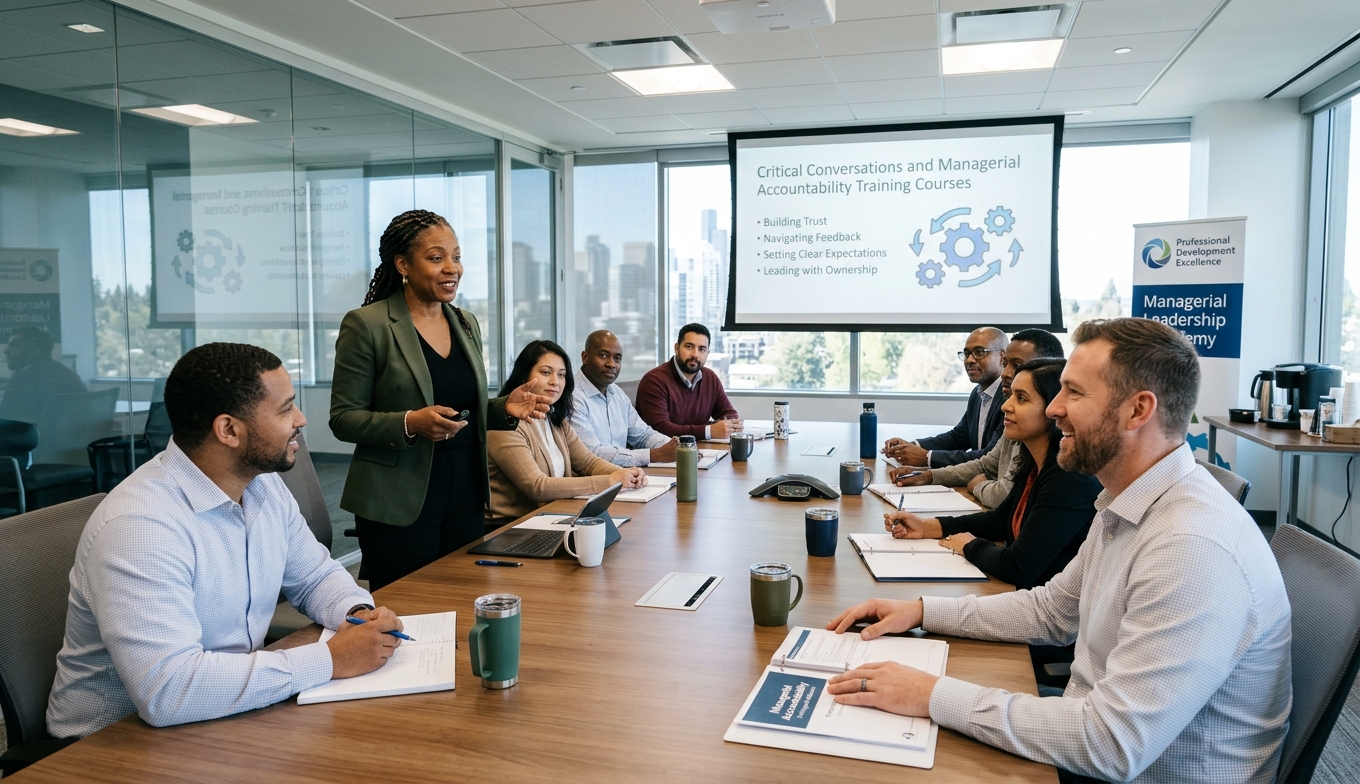
Critical Conversations and Managerial Accountability Training Courses offered by the Geneva Institute of Business Management are designed to strengthen managerial communication, improve accountability, and establish a consistent approach to addressing important workplace issues. Effective management requires leaders to communicate clearly, address performance concerns, clarify expectations, and maintain professional relationships while making difficult decisions. When managers avoid challenging discussions or fail to address problems directly, organisational performance, employee engagement, and operational standards can suffer.
Critical conversations are an essential part of effective leadership and management. They provide managers with a structured approach to discussing sensitive matters, resolving disagreements, addressing underperformance, and ensuring that individuals understand their responsibilities. These discussions often involve different perspectives, competing priorities, missed targets, behavioural concerns, and decisions that require direct communication. Managers who handle these situations professionally can reduce misunderstandings, strengthen workplace relationships, and create greater accountability across teams.
The Geneva Institute of Business Management delivers these training courses through a corporate-focused approach that connects communication practices with organisational objectives. The programmes focus on practical managerial situations where leaders must address complex issues, communicate decisions, provide constructive feedback, and ensure that agreed actions lead to measurable outcomes. Participants develop the ability to manage difficult dialogue without creating unnecessary conflict or weakening professional relationships.
Accountability conversations are particularly important when employees do not meet agreed standards, responsibilities remain unclear, or performance expectations are not being achieved. Managers must be capable of identifying the underlying issues, explaining the impact of specific behaviours, and agreeing on corrective actions. These conversations require preparation, emotional awareness, professional judgement, and the ability to maintain a clear focus on business outcomes.
The programmes also address the relationship between managerial accountability and organisational culture. A workplace that promotes accountability requires managers to establish transparent expectations, communicate responsibilities consistently, and follow up on commitments. Employees must understand what is expected of them, how their performance is assessed, and what actions are required when results fall below established standards.
Another important area is the management of performance discussions. These conversations influence employee development, productivity, professional conduct, and the achievement of departmental targets. Managers need to distinguish between performance-related issues, behavioural concerns, capability gaps, and organisational obstacles. Addressing these matters through structured communication enables leaders to make informed decisions and establish appropriate improvement measures.
The training also strengthens feedback practices. Constructive feedback allows managers to recognise effective contributions, identify performance gaps, and communicate opportunities for improvement. When feedback is specific, timely, and supported by relevant evidence, employees are more likely to understand its purpose and respond with appropriate action. Managers also learn to receive feedback professionally and use it to improve their own leadership effectiveness.
Within the wider scope of Leadership and Management Training Courses, Critical Conversations and Managerial Accountability Training Courses support organisations seeking stronger management practices, clearer communication standards, and improved responsibility across their workforce. The programmes are relevant to businesses operating in complex environments where managers must balance employee relationships, operational requirements, performance expectations, and organisational priorities.
Through the Geneva Institute of Business Management, organisations can strengthen their managerial communication frameworks and develop a more consistent approach to challenging workplace discussions. The overall focus is on helping managers address important issues confidently, maintain professional standards, and translate conversations into clear decisions, measurable commitments, and accountable action.
Objectives
The Critical Conversations and Managerial Accountability Training Courses aim to strengthen the communication capabilities and accountability practices required for effective organisational leadership. The programmes focus on enabling managers to handle sensitive workplace discussions while maintaining clarity, professionalism, and alignment with business objectives.
Key objectives include:
1. Strengthening Critical Conversation Skills
Develop the ability to recognise situations that require critical conversations and approach them with appropriate preparation, professional judgement, and confidence. Managers learn to communicate difficult messages clearly while maintaining constructive working relationships.
2. Improving Managerial Communication
Strengthen managerial communication through structured messaging, active listening, professional questioning, and clear explanations. Managers develop the ability to communicate decisions, responsibilities, concerns, and expectations without creating unnecessary confusion.
3. Establishing Effective Accountability Conversations
Develop consistent approaches to accountability conversations that address missed commitments, performance gaps, workplace behaviour, and responsibility-related concerns. Managers learn to focus discussions on facts, agreed standards, and corrective action.
4. Clarifying Roles and Performance Expectations
Improve the communication of individual responsibilities, departmental priorities, performance standards, and expected outcomes. The objective is to ensure that employees understand their obligations and recognise how their contributions support wider organisational performance.
5. Managing Difficult Dialogue Professionally
Strengthen the ability to conduct difficult dialogue involving disagreement, sensitive feedback, conflicting expectations, and challenging workplace situations. Managers learn to remain objective, control emotional reactions, and maintain productive discussions.
6. Improving Performance Discussions
Develop structured methods for discussing employee performance, identifying gaps, reviewing progress, and agreeing on improvement priorities. Managers gain greater confidence in addressing underperformance before it affects wider organisational results.
7. Delivering Constructive Feedback
Improve feedback practices by focusing on specific behaviours, measurable outcomes, and actionable recommendations. Managers learn to communicate positive and corrective feedback in a balanced and professional manner.
8. Strengthening Managerial Accountability
Establish stronger accountability standards by connecting responsibilities with measurable commitments and follow-up processes. Managers develop the ability to demonstrate accountability themselves while ensuring that employees take ownership of their work.
9. Resolving Workplace Disagreements
Improve the management of disagreements through structured communication, evidence-based discussions, and practical problem-solving. Managers learn to identify the underlying causes of conflict and guide conversations towards workable solutions.
10. Building Consistent Follow-Up Practices
Develop reliable approaches for documenting decisions, monitoring agreed actions, reviewing progress, and addressing recurring performance concerns. This objective supports a culture where commitments are treated as measurable responsibilities.
11. Supporting Organisational Performance
Connect effective communication and managerial accountability with operational efficiency, employee contribution, departmental performance, and strategic priorities. Managers learn to ensure that important conversations produce practical organisational outcomes.
Target Audience
The Critical Conversations and Managerial Accountability Training Courses are intended for professionals responsible for managing employees, supervising teams, addressing workplace challenges, and maintaining organisational performance standards. The programmes are particularly relevant to organisations seeking consistent communication practices and stronger accountability across management levels.
Senior Executives and Business Leaders
Senior executives responsible for organisational direction, leadership standards, and business performance can strengthen their ability to address critical issues with department heads and management teams. The programmes support executive communication, accountability frameworks, and discussions involving strategic priorities, leadership performance, and organisational responsibilities.
Department Heads and Functional Managers
Department heads managing operational responsibilities, departmental targets, and employee performance can improve their ability to conduct performance discussions, communicate expectations, and address gaps in delivery. The training supports consistent managerial practices across departments.
Middle Managers
Middle managers frequently operate between senior leadership and operational teams. They must communicate management decisions, resolve workplace concerns, monitor performance, and ensure that responsibilities are fulfilled. These programmes strengthen their ability to manage difficult dialogue and maintain accountability.
Team Leaders and Supervisors
Team leaders and supervisors responsible for daily operations can develop practical skills for addressing missed deadlines, communication breakdowns, behavioural concerns, and inconsistent work standards. The programmes help them manage difficult conversations without allowing unresolved issues to affect team performance.
Human Resources Managers and HR Business Partners
HR professionals involved in employee relations, performance management, workplace conduct, and management support can improve their understanding of structured accountability conversations. The programmes also support collaboration between HR departments and line managers when handling sensitive workplace matters.
Project Managers and Programme Managers
Project and programme managers responsible for deliverables, deadlines, resource allocation, and stakeholder expectations can strengthen their ability to address missed commitments and performance concerns. The training supports accountability across project teams and professional relationships.
Operations and Business Unit Managers
Operations managers and business unit leaders can improve communication around service standards, productivity, operational responsibilities, and performance targets. The programmes support the identification of problems and the implementation of corrective measures.
Emerging Managers and Newly Appointed Leaders
Professionals transitioning into management positions can establish effective communication and accountability practices from the beginning of their leadership responsibilities. The training provides a structured foundation for addressing workplace concerns, communicating expectations, and managing employee performance.
Organisational Development and Learning Professionals
Professionals responsible for management development, leadership capability, and organisational effectiveness can use the programme's approaches to support consistent communication standards and accountability practices throughout their organisations.
Modules
Module 1: Foundations of Critical Conversations in Management
-
Understanding the purpose and importance of critical conversations in organisational management.
-
Identifying situations that require direct managerial intervention.
-
Distinguishing routine communication from conversations involving significant workplace concerns.
-
Understanding the relationship between communication, trust, and managerial accountability.
-
Recognising the organisational consequences of avoiding difficult discussions.
-
Establishing professional standards for sensitive management conversations.
-
Connecting critical conversations with organisational priorities and performance requirements.
Module 2: Managerial Communication and Professional Dialogue
-
Understanding the principles of effective managerial communication.
-
Developing clear and structured communication approaches.
-
Communicating complex messages without unnecessary ambiguity.
-
Applying active listening and professional questioning techniques.
-
Understanding verbal and non-verbal communication during challenging discussions.
-
Adapting communication styles to different personalities and workplace situations.
-
Maintaining professionalism when discussing sensitive organisational matters.
-
Ensuring that managerial messages are consistent with organisational policies and objectives.
Module 3: Planning and Preparing for Critical Conversations
-
Identifying the central issue before initiating a difficult discussion.
-
Establishing clear objectives and desired outcomes.
-
Gathering relevant information, evidence, and performance records.
-
Distinguishing facts from assumptions and personal interpretations.
-
Selecting appropriate timing and communication settings.
-
Anticipating possible reactions, disagreements, and concerns.
-
Establishing an appropriate conversation structure.
-
Preparing questions that encourage constructive responses.
-
Identifying potential solutions and corrective actions before the discussion.
Module 4: Accountability Conversations and Responsibility Management
-
Understanding accountability as a fundamental management responsibility.
-
Establishing ownership of tasks, decisions, and performance outcomes.
-
Conducting accountability conversations when commitments are not fulfilled.
-
Addressing repeated delays, missed targets, and incomplete responsibilities.
-
Communicating the consequences of performance gaps.
-
Distinguishing accountability from blame and personal criticism.
-
Encouraging employees to acknowledge their responsibilities.
-
Agreeing on corrective actions and measurable commitments.
-
Establishing follow-up procedures to monitor accountability.
Module 5: Managing Difficult Dialogue and Workplace Conflict
-
Identifying the causes of difficult workplace conversations.
-
Addressing disagreement between managers and employees.
-
Managing conversations involving conflicting priorities and expectations.
-
Recognising emotional triggers during sensitive discussions.
-
Maintaining composure when faced with resistance or defensiveness.
-
Applying de-escalation techniques to prevent unnecessary conflict.
-
Addressing misunderstandings through clarification and evidence.
-
Managing conversations involving challenging workplace behaviour.
-
Redirecting unproductive discussions towards practical solutions.
Module 6: Performance Discussions and Performance Improvement
-
Understanding the relationship between performance management and managerial communication.
-
Establishing clear performance standards and evaluation criteria.
-
Preparing structured performance discussions.
-
Addressing missed objectives and inconsistent work quality.
-
Identifying performance gaps and their underlying causes.
-
Distinguishing capability issues from motivation and resource-related challenges.
-
Communicating performance concerns using specific evidence.
-
Agreeing on individual performance improvement actions.
-
Monitoring progress against established performance expectations.
-
Maintaining consistent communication throughout the performance management process.
Module 7: Delivering Constructive Feedback and Corrective Guidance
-
Understanding the role of feedback in managerial effectiveness.
-
Distinguishing constructive feedback from personal criticism.
-
Communicating positive and corrective feedback appropriately.
-
Using specific examples to explain performance observations.
-
Addressing behavioural concerns without damaging professional relationships.
-
Providing feedback that supports measurable improvement.
-
Managing employee reactions to challenging feedback.
-
Encouraging employees to participate in improvement discussions.
-
Establishing a consistent feedback culture within management teams.
Module 8: Communicating Expectations and Performance Standards
-
Defining individual and departmental expectations.
-
Communicating responsibilities and expected deliverables.
-
Establishing measurable standards for employee performance.
-
Connecting individual responsibilities with organisational objectives.
-
Addressing unclear instructions and conflicting expectations.
-
Ensuring consistency between management decisions and communicated requirements.
-
Clarifying deadlines, priorities, and quality standards.
-
Confirming mutual understanding of agreed responsibilities.
-
Reviewing expectations when organisational priorities change.
Module 9: Emotional Intelligence in Critical Conversations
-
Understanding the influence of emotional intelligence on managerial communication.
-
Recognising emotional responses during difficult dialogue.
-
Developing self-awareness and emotional regulation.
-
Understanding different employee reactions to challenging discussions.
-
Demonstrating empathy without compromising management standards.
-
Maintaining objectivity when addressing sensitive issues.
-
Responding professionally to frustration, disagreement, and resistance.
-
Building trust through respectful and consistent communication.
-
Balancing professional relationships with organisational accountability.
Module 10: Managing Resistance and Challenging Employee Responses
-
Identifying common forms of resistance during accountability conversations.
-
Understanding the reasons behind defensive communication.
-
Addressing denial, disagreement, and avoidance of responsibility.
-
Responding to repeated explanations without losing focus on the issue.
-
Using evidence-based communication to clarify concerns.
-
Encouraging constructive participation and problem-solving.
-
Maintaining managerial authority without unnecessary confrontation.
-
Establishing boundaries and professional expectations.
-
Concluding challenging conversations with clear responsibilities.
Module 11: Decision-Making, Action Planning, and Follow-Up
-
Translating critical conversations into practical management decisions.
-
Establishing clear action plans following difficult discussions.
-
Assigning responsibilities and realistic deadlines.
-
Documenting agreed outcomes and performance commitments.
-
Monitoring progress through structured review processes.
-
Addressing incomplete actions and recurring performance gaps.
-
Establishing appropriate escalation procedures.
-
Evaluating the effectiveness of corrective measures.
-
Ensuring consistency between discussions, decisions, and implementation.
Module 12: Building a Culture of Managerial Accountability
-
Understanding the characteristics of an accountable organisational culture.
-
Establishing consistent communication standards across management teams.
-
Encouraging ownership and responsibility at every organisational level.
-
Integrating accountability into everyday managerial practices.
-
Promoting transparency in performance expectations and decisions.
-
Strengthening trust through consistent management behaviour.
-
Aligning employee responsibilities with departmental objectives.
-
Addressing recurring communication and accountability challenges.
-
Supporting continuous improvement through regular performance discussions.
-
Establishing long-term practices that reinforce organisational effectiveness.
FAQs
1. What are Critical Conversations in managerial leadership?
Critical Conversations are structured discussions between managers and employees about important workplace matters, including performance concerns, responsibilities, behavioural issues, disagreements, and organisational expectations. They help managers address sensitive situations professionally and establish clear decisions and actionable outcomes.
2. Why are accountability conversations important for managers?
Accountability conversations help managers ensure that employees understand their responsibilities and take ownership of their commitments. They also provide a structured approach to addressing missed targets, incomplete tasks, and performance gaps while supporting organisational standards and productivity.
3. How do Critical Conversations improve managerial communication?
Critical Conversations improve managerial communication by strengthening active listening, clear messaging, constructive feedback, and professional dialogue. They help managers address difficult subjects directly, reduce misunderstandings, clarify expectations, and maintain productive working relationships.
4. Who should attend Critical Conversations and Managerial Accountability Training Courses?
These programmes are suitable for senior executives, department heads, middle managers, team leaders, supervisors, HR professionals, project managers, and operations managers. They are particularly relevant to professionals responsible for employee performance, workplace communication, accountability, and organisational decision-making.
5. How do performance discussions support managerial accountability?
Performance discussions support managerial accountability by connecting individual responsibilities with measurable objectives and expected outcomes. They allow managers to identify performance gaps, provide constructive feedback, agree on improvement actions, and monitor progress through consistent follow-up.
Venues and dates
This programme runs every month in the following cities. Select a venue to register.
 Geneva
Switzerland
 Zurich
Switzerland
Basel
Switzerland
 London
UK
 Manchester
UK
 Oxford
UK
 Madrid
Spain
 Barcelona
Spain
 Paris
France
 Rome
Italy
 Vienna
Austria
Oslo
Norway
 Athens
Greece
 Copenhagen
Denmark
 Berlin
Germany
 Munich
Germany
 New York
USA
 Washington
USA
 Dubai
UAE
 Istanbul
Turkey
 Amsterdam
Netherlands
 Brussels
Belgium
 Lisbon
Portugal
 Malaga
Spain
 Milan
Italy
 Dusseldorf
Germany
 Prague
Czech Republic
 Budapest
Hungary
 Stockholm
Sweden
 Sheffield
UK
 Bangor
UK
 Ankara
Turkey
 Abu Dhabi
UAE
 Doha
Qatar
 Riyadh
Saudi Arabia
 Jeddah
Saudi Arabia
 Dammam
Saudi Arabia
 Muscat
Oman
 Amman
Jordan
 Cairo
Egypt
 Sharm El Sheikh
Egypt
 Casablanca
Morocco
 Marrakesh
Morocco
 Agadir
Morocco
 Tangier
Morocco
 Tunis
Tunisia
 Kuala Lumpur
Malaysia
 Singapore
 Jakarta
Indonesia
 Phuket
Thailand
 Tokyo
Japan
 Beijing
China
 Los Angeles
USA
 California
USA
 Toronto
Canada