Summary
The Geneva Institute of Business Management offers the Design Thinking for Leaders and Managers Training Courses to strengthen the ability of organisational leaders, senior executives, department heads, and managers to address complex business challenges through human-centred design, innovation, and structured problem-solving. In an increasingly competitive business environment, organisations require leadership approaches that encourage creative thinking, improve decision-making, and develop practical solutions around customer expectations, employee needs, and strategic priorities. Design Thinking provides a structured framework that enables leaders to understand challenges from different perspectives, identify opportunities, generate innovative ideas, and transform concepts into valuable business outcomes.
These Design Thinking Training Courses focus on integrating human-centred design principles into leadership and management practices. The programme explores how leaders can understand the experiences of customers, employees, stakeholders, and business partners before developing solutions. Rather than relying exclusively on traditional management assumptions, participants examine how observation, research, collaboration, ideation, and experimentation can improve organisational performance. This approach helps decision-makers identify the underlying causes of business problems and develop solutions that respond to genuine organisational requirements.
Design Thinking is an important management capability because modern organisations operate in environments characterised by changing customer expectations, technological developments, operational pressures, and increasing competition. Leaders must continuously evaluate existing processes, recognise emerging opportunities, and adapt their strategies to changing conditions. The programme introduces practical methods that support innovation leadership, enabling managers to create an environment where employees contribute ideas, challenge established practices, and participate in developing better solutions.
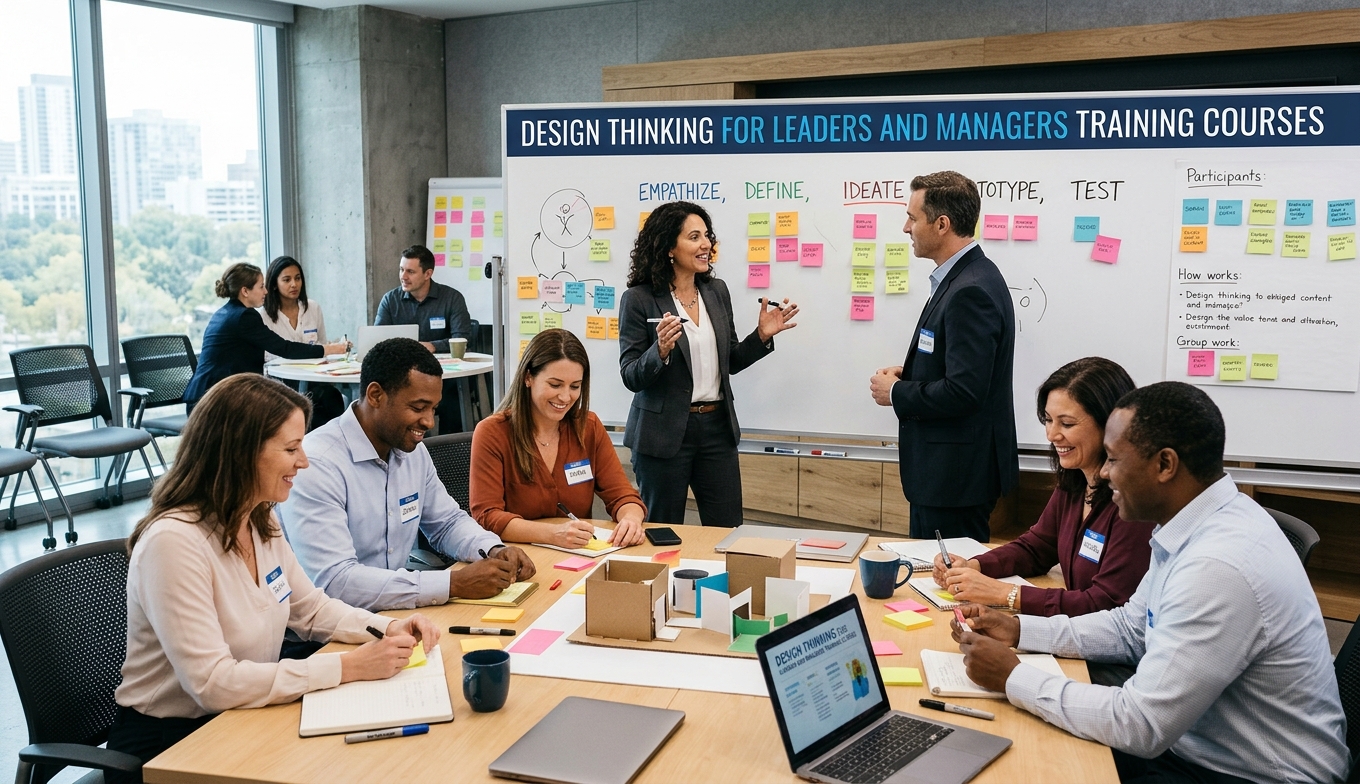
A central component of the training is the relationship between Design Thinking and strategic problem-solving. Participants explore how to define business challenges accurately, distinguish between symptoms and underlying problems, and identify opportunities for improvement. The programme examines the stages of the Design Thinking process, including empathy, problem definition, ideation, prototyping, and testing. These stages provide a practical structure for addressing challenges involving customer experience, organisational processes, service delivery, workforce engagement, and business development.
The programme also examines the role of leadership in developing an innovation-oriented organisational culture. Managers influence how employees approach uncertainty, respond to challenges, exchange ideas, and implement change. By applying Design Thinking principles, leaders can encourage cross-functional collaboration, strengthen communication, and support constructive experimentation. These capabilities help organisations move beyond conventional problem-solving methods and develop more responsive approaches to operational and strategic management.
Another important focus is the practical application of ideation and prototyping in business environments. Leaders examine how to facilitate productive brainstorming sessions, evaluate alternative solutions, and transform promising ideas into prototypes that can be assessed before full implementation. This reduces dependence on assumptions and allows organisations to identify weaknesses, gather feedback, and improve proposed solutions. The process also supports more informed resource allocation and reduces the risks associated with implementing untested business initiatives.
The Design Thinking for Leaders and Managers Training Courses offered by the Geneva Institute of Business Management connect creative problem-solving with organisational objectives. Participants explore how human-centred design can contribute to customer satisfaction, employee engagement, service improvement, operational efficiency, and sustainable innovation. The programme positions Design Thinking as a practical management approach rather than an isolated creative activity.
As part of the Leadership and Management Training Courses category, this programme supports professionals responsible for leading teams, managing organisational change, developing business strategies, and improving workplace performance. It strengthens their ability to combine analytical thinking with creativity, ensuring that innovative ideas remain connected to measurable organisational priorities.
Through practical management frameworks and business-focused applications, the programme helps leaders establish more effective approaches to identifying challenges, developing ideas, testing solutions, and managing innovation. It supports organisations seeking to improve adaptability, strengthen their competitive position, and create long-term value through human-centred innovation.
Objectives
The Design Thinking for Leaders and Managers Training Courses aim to develop the leadership capabilities required to manage innovation, improve organisational problem-solving, and introduce human-centred approaches to business management. The programme focuses on practical competencies that enable managers to translate creative thinking into structured initiatives and measurable organisational improvements.
The main objectives include:
1. Develop a Strategic Understanding of Design Thinking
-
Establish a clear understanding of Design Thinking and its relevance to contemporary leadership and management.
-
Examine how human-centred design principles contribute to business innovation and organisational development.
-
Understand the relationship between Design Thinking, strategic planning, and business transformation.
-
Identify opportunities to integrate Design Thinking into existing management frameworks.
-
Evaluate how creative approaches can improve organisational competitiveness and long-term performance.
2. Strengthen Human-Centred Leadership
-
Develop the ability to consider customer, employee, and stakeholder perspectives when making management decisions.
-
Apply empathy-based approaches to understand business requirements and organisational challenges.
-
Improve leadership awareness of customer experience and employee expectations.
-
Identify gaps between organisational assumptions and actual stakeholder needs.
-
Encourage management practices that place people and practical business requirements at the centre of decision-making.
3. Improve Organisational Problem-Solving
-
Strengthen the ability to identify complex business challenges and their underlying causes.
-
Apply structured problem-solving techniques to operational and strategic management issues.
-
Distinguish between immediate business symptoms and fundamental organisational problems.
-
Develop alternative approaches to addressing performance, service, and management challenges.
-
Improve decision-making through research, analysis, collaboration, and experimentation.
4. Enhance Innovation and Ideation Capabilities
-
Introduce effective ideation techniques for generating relevant business solutions.
-
Develop the ability to facilitate brainstorming and collaborative innovation sessions.
-
Encourage employees to contribute creative ideas and challenge conventional practices.
-
Evaluate innovative concepts according to organisational priorities and available resources.
-
Establish a working environment that supports experimentation and continuous improvement.
5. Apply Prototyping and Testing Methods
-
Understand how prototyping translates ideas into practical and assessable solutions.
-
Develop the ability to create basic prototypes for services, processes, and management initiatives.
-
Apply feedback mechanisms to evaluate proposed solutions.
-
Identify potential implementation problems before committing significant resources.
-
Improve solutions through continuous testing, evaluation, and refinement.
6. Strengthen Innovation Leadership and Team Collaboration
-
Develop leadership techniques that encourage creative participation and cross-functional cooperation.
-
Improve communication between departments involved in innovation initiatives.
-
Build confidence in managing uncertainty and supporting experimental approaches.
-
Encourage accountability while allowing teams sufficient flexibility to explore solutions.
-
Integrate innovation objectives into team management and organisational performance frameworks.
7. Support Organisational Change and Transformation
-
Apply Design Thinking principles to organisational change initiatives.
-
Identify opportunities to redesign inefficient processes and improve service delivery.
-
Strengthen management capabilities for introducing new ideas across departments.
-
Align innovation initiatives with organisational strategies and performance objectives.
-
Develop approaches for evaluating the long-term impact of design-led business improvements.
Target Audience
The Design Thinking for Leaders and Managers Training Courses are designed for professionals responsible for organisational leadership, strategic decision-making, business development, innovation management, and operational improvement. The programme is particularly relevant to individuals who need to address complex challenges, improve collaboration, and introduce creative approaches within their organisations.
The target audience includes:
1. Senior Executives and Business Leaders
Chief executive officers, managing directors, executive directors, and senior decision-makers responsible for organisational strategy and business performance. These professionals can use Design Thinking to identify new business opportunities, improve strategic decisions, and encourage innovation across organisational structures.
2. Department Heads and Functional Managers
Department directors, operational managers, and functional leaders who oversee teams, resources, and departmental performance. The programme helps them apply human-centred design and structured problem-solving to improve workflows, strengthen collaboration, and address operational challenges.
3. Innovation and Transformation Managers
Professionals responsible for managing innovation programmes, organisational transformation, and business improvement initiatives. They can strengthen their ability to facilitate ideation, evaluate innovative concepts, develop prototypes, and introduce practical solutions aligned with strategic priorities.
4. Project Managers and Programme Directors
Project management professionals who coordinate complex initiatives, manage stakeholders, and oversee implementation activities. The programme provides approaches for understanding stakeholder requirements, identifying potential project challenges, and testing proposed solutions before full-scale execution.
5. Human Resources Directors and HR Managers
HR professionals responsible for employee experience, workforce development, organisational culture, and talent management. They can apply Design Thinking to improve recruitment processes, employee engagement, workplace communication, and internal service delivery.
6. Marketing and Customer Experience Managers
Marketing directors, customer experience managers, and service development professionals who need to understand customer expectations and improve service quality. The programme introduces human-centred design techniques that support customer research, experience improvement, and innovative service development.
7. Business Development and Strategy Professionals
Business strategists, consultants, and business development managers involved in identifying growth opportunities and developing competitive strategies. They can use Design Thinking to explore market challenges, generate business concepts, and evaluate potential opportunities through structured experimentation.
8. Operations and Process Improvement Managers
Operations directors, quality managers, and process improvement specialists responsible for organisational efficiency and service delivery. The programme supports their ability to identify process weaknesses, redesign workflows, and develop solutions that improve productivity and operational performance.
9. Team Leaders and Supervisors
Team leaders and supervisors who manage employees, coordinate daily activities, and resolve workplace challenges. The training strengthens their ability to encourage employee participation, facilitate creative discussions, and introduce practical improvements within their teams.
10. Consultants and Organisational Development Specialists
Management consultants and organisational development professionals who advise businesses on strategy, transformation, and performance improvement. The programme provides additional frameworks for understanding client requirements, facilitating innovation, and developing solutions around organisational needs.
Modules
The Design Thinking for Leaders and Managers Training Courses are structured around essential concepts, practical frameworks, and management applications. The modules progressively develop participants' understanding of human-centred design, innovation, problem-solving, ideation, prototyping, and leadership.
Module 1: Introduction to Design Thinking in Leadership and Management
-
Definition, principles, and business applications of Design Thinking.
-
The evolution of Design Thinking as an approach to organisational innovation.
-
Differences between traditional management approaches and design-led problem-solving.
-
The importance of human-centred design in contemporary business environments.
-
The relationship between Design Thinking, leadership, and organisational strategy.
-
The role of creativity and innovation in management decision-making.
-
Identifying opportunities for Design Thinking across organisational functions.
-
Integrating design-led approaches into existing business management practices.
Module 2: Human-Centred Design and Stakeholder Understanding
-
Principles and importance of human-centred design.
-
Understanding customer, employee, and stakeholder expectations.
-
Identifying stakeholder needs through observation and research.
-
Applying empathy techniques to understand business challenges.
-
Developing stakeholder profiles and user personas.
-
Mapping customer journeys and employee experiences.
-
Identifying gaps between organisational assumptions and stakeholder requirements.
-
Using qualitative insights to support management decisions.
-
Translating stakeholder feedback into actionable business opportunities.
Module 3: Strategic Problem Identification and Definition
-
Identifying complex organisational and management challenges.
-
Understanding the root causes of business problems.
-
Applying problem-framing techniques to management situations.
-
Distinguishing between symptoms, causes, and underlying requirements.
-
Developing clear and actionable problem statements.
-
Using analytical questioning to challenge existing assumptions.
-
Prioritising challenges according to business impact and strategic relevance.
-
Connecting problem definition with organisational objectives.
-
Establishing measurable criteria for evaluating potential solutions.
Module 4: Innovation Leadership and Creative Management
-
Understanding the relationship between leadership and organisational innovation.
-
Developing leadership behaviours that encourage creative thinking.
-
Creating an organisational culture that supports innovation.
-
Managing uncertainty and encouraging responsible experimentation.
-
Overcoming resistance to new ideas and alternative approaches.
-
Supporting employee participation in innovation initiatives.
-
Encouraging cross-functional communication and knowledge sharing.
-
Balancing creativity with organisational accountability.
-
Integrating innovation objectives into leadership and management strategies.
Module 5: Ideation Techniques and Collaborative Problem-Solving
-
Understanding the role of ideation in the Design Thinking process.
-
Applying structured brainstorming techniques.
-
Facilitating creative workshops and collaborative discussions.
-
Using mind mapping to explore alternative business solutions.
-
Applying divergent and convergent thinking approaches.
-
Encouraging participation from employees with different professional backgrounds.
-
Challenging conventional assumptions through creative questioning.
-
Generating multiple solutions to complex organisational problems.
-
Evaluating ideas according to feasibility, relevance, and business value.
-
Selecting promising concepts for further development.
Module 6: Prototyping and Business Solution Development
-
Understanding prototyping as a stage of the Design Thinking process.
-
Translating innovative concepts into practical solutions.
-
Developing low-fidelity prototypes for business applications.
-
Creating service and process prototypes.
-
Using visual models and process maps to communicate proposed solutions.
-
Identifying the resources required for prototype development.
-
Evaluating prototype performance against defined objectives.
-
Recognising implementation weaknesses at an early stage.
-
Refining business concepts through practical experimentation.
-
Preparing innovative solutions for organisational implementation.
Module 7: Testing, Feedback, and Continuous Improvement
-
Understanding the importance of testing in Design Thinking.
-
Establishing appropriate testing objectives and evaluation criteria.
-
Collecting feedback from customers, employees, and stakeholders.
-
Analysing responses to prototypes and proposed solutions.
-
Identifying performance gaps and areas requiring modification.
-
Applying iterative improvement techniques.
-
Using feedback to strengthen business decisions.
-
Evaluating solution effectiveness before full implementation.
-
Establishing continuous improvement mechanisms.
-
Connecting testing outcomes with organisational performance indicators.
Module 8: Design Thinking for Strategic Decision-Making
-
Applying Design Thinking to complex strategic management decisions.
-
Integrating human-centred insights into business planning.
-
Evaluating alternative strategies through creative problem-solving.
-
Identifying opportunities for new services, products, and business models.
-
Assessing organisational risks associated with innovation initiatives.
-
Balancing customer requirements with operational and financial considerations.
-
Using experimentation to support strategic decisions.
-
Aligning innovative solutions with corporate objectives.
-
Developing long-term approaches to strategic innovation.
Module 9: Managing Teams Through Design Thinking
-
Establishing collaborative working environments.
-
Encouraging employee participation in problem-solving activities.
-
Facilitating cross-functional innovation teams.
-
Managing different perspectives during ideation sessions.
-
Improving communication between departments and management levels.
-
Assigning responsibilities for innovation projects.
-
Addressing conflicts during creative discussions.
-
Building accountability into collaborative initiatives.
-
Supporting team performance through human-centred management.
-
Developing leadership practices that encourage continuous innovation.
Module 10: Design Thinking for Customer Experience and Service Innovation
-
Understanding customer experience as a business performance factor.
-
Applying customer journey mapping to identify service weaknesses.
-
Identifying customer pain points and unmet expectations.
-
Developing innovative approaches to service improvement.
-
Using customer feedback to support service redesign.
-
Improving interactions across customer touchpoints.
-
Connecting customer experience initiatives with organisational strategy.
-
Applying prototyping to test service improvements.
-
Evaluating customer satisfaction and service performance.
-
Establishing customer-centred innovation practices.
Module 11: Organisational Transformation and Change Management
-
Applying Design Thinking to organisational transformation.
-
Identifying opportunities for improving organisational processes.
-
Redesigning workflows through human-centred approaches.
-
Managing employee concerns during innovation and change initiatives.
-
Building support for new management practices.
-
Integrating design-led methods into change management programmes.
-
Evaluating the organisational impact of proposed improvements.
-
Coordinating innovation activities across business functions.
-
Developing implementation plans for innovative solutions.
-
Maintaining continuous improvement after organisational changes.
Module 12: Measuring Innovation Performance and Business Impact
-
Establishing performance indicators for Design Thinking initiatives.
-
Measuring the effectiveness of innovation projects.
-
Evaluating the commercial and operational value of new solutions.
-
Assessing improvements in customer and employee experience.
-
Measuring efficiency gains and process improvements.
-
Evaluating the return on investment of innovation activities.
-
Monitoring the implementation of design-led solutions.
-
Identifying opportunities for further development.
-
Reporting innovation outcomes to senior management.
-
Integrating Design Thinking into long-term organisational performance strategies.
Module 13: Practical Application and Design Thinking Implementation Strategy
-
Applying the complete Design Thinking framework to organisational challenges.
-
Selecting business problems suitable for design-led intervention.
-
Conducting stakeholder analysis and defining core requirements.
-
Developing problem statements and generating innovative ideas.
-
Creating prototypes and establishing testing procedures.
-
Collecting feedback and refining proposed solutions.
-
Preparing implementation strategies for selected initiatives.
-
Assigning leadership responsibilities and organisational resources.
-
Establishing performance measurement and evaluation mechanisms.
-
Developing a sustainable framework for integrating Design Thinking into management practices.
FAQs
1. What is Design Thinking in leadership and management?
Design Thinking is a human-centred approach to identifying business challenges and developing innovative solutions. In leadership and management, it helps decision-makers understand stakeholder needs, improve problem-solving, encourage collaboration, and introduce practical improvements across organisational functions.
2. Why is Design Thinking important for business leaders and managers?
Design Thinking helps business leaders address complex challenges through creativity, structured analysis, and experimentation. It strengthens innovation, improves decision-making, supports customer-focused strategies, and enables managers to develop solutions that respond to organisational and stakeholder requirements.
3. What are the five stages of the Design Thinking process?
The five commonly recognised stages are empathy, defining the problem, ideation, prototyping, and testing. These stages help leaders understand stakeholder needs, identify the actual problem, generate ideas, develop practical solutions, and evaluate their effectiveness through feedback.
4. How does Design Thinking improve organisational innovation?
Design Thinking improves organisational innovation by encouraging employees and managers to explore different perspectives, challenge assumptions, and develop alternative solutions. Its emphasis on ideation, prototyping, and testing helps organisations evaluate new concepts and introduce improvements based on practical feedback.
5. Who should attend the Design Thinking for Leaders and Managers Training Courses?
These courses are suitable for senior executives, department heads, business managers, project directors, innovation managers, HR professionals, operations managers, and team leaders. They are particularly relevant to professionals responsible for strategic decision-making, organisational development, innovation, and business performance improvement.
Venues and dates
This programme runs every month in the following cities. Select a venue to register.
 Geneva
Switzerland
 Zurich
Switzerland
Basel
Switzerland
 London
UK
 Manchester
UK
 Oxford
UK
 Madrid
Spain
 Barcelona
Spain
 Paris
France
 Rome
Italy
 Vienna
Austria
Oslo
Norway
 Athens
Greece
 Copenhagen
Denmark
 Berlin
Germany
 Munich
Germany
 New York
USA
 Washington
USA
 Dubai
UAE
 Istanbul
Turkey
 Amsterdam
Netherlands
 Brussels
Belgium
 Lisbon
Portugal
 Malaga
Spain
 Milan
Italy
 Dusseldorf
Germany
 Prague
Czech Republic
 Budapest
Hungary
 Stockholm
Sweden
 Sheffield
UK
 Bangor
UK
 Ankara
Turkey
 Abu Dhabi
UAE
 Doha
Qatar
 Riyadh
Saudi Arabia
 Jeddah
Saudi Arabia
 Dammam
Saudi Arabia
 Muscat
Oman
 Amman
Jordan
 Cairo
Egypt
 Sharm El Sheikh
Egypt
 Casablanca
Morocco
 Marrakesh
Morocco
 Agadir
Morocco
 Tangier
Morocco
 Tunis
Tunisia
 Kuala Lumpur
Malaysia
 Singapore
 Jakarta
Indonesia
 Phuket
Thailand
 Tokyo
Japan
 Beijing
China
 Los Angeles
USA
 California
USA
 Toronto
Canada