Summary
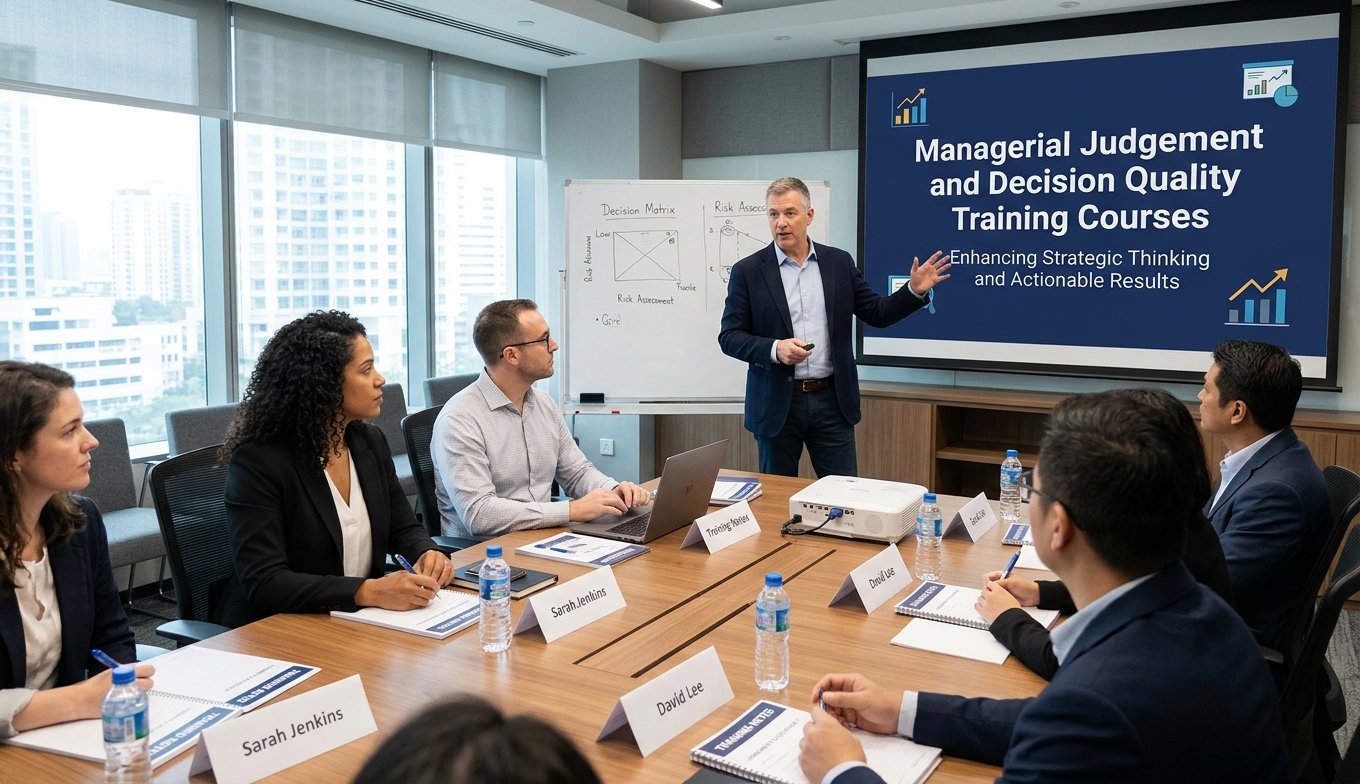
The Geneva Institute of Business Management offers Managerial Judgement and Decision Quality Training Courses designed to strengthen the decision-making capabilities of managers, senior executives, department heads, and organisational leaders. In today's complex business environment, managerial judgement plays a critical role in determining organisational direction, managing uncertainty, allocating resources, and achieving sustainable business performance. Leaders regularly face situations that require them to evaluate competing priorities, interpret incomplete information, assess potential risks, and make decisions that influence operational efficiency and long-term organisational success.
Managerial judgement is more than the ability to select between available alternatives. It involves understanding business circumstances, recognising relevant information, evaluating consequences, and applying professional experience to reach well-reasoned conclusions. Effective managerial judgment enables leaders to balance analytical evidence with practical experience, organisational objectives, stakeholder expectations, and changing market conditions. When supported by strong decision quality, this capability helps organisations reduce avoidable mistakes, improve accountability, and maintain consistency in strategic and operational decisions.
The programme focuses on developing a structured approach to managerial decision-making. It examines how managers identify business problems, distinguish between assumptions and verified information, evaluate alternative solutions, and apply appropriate decision frameworks. Participants gain an understanding of the factors that influence judgement, including cognitive biases, organisational pressures, incomplete information, time constraints, and conflicting stakeholder interests. These considerations are particularly important for executives responsible for decisions involving financial resources, workforce management, operational priorities, business development, and organisational transformation.
A central component of the training is the relationship between analytical thinking and managerial judgement. Managers must be able to interpret quantitative and qualitative information without overlooking the broader organisational context. Analytical thinking supports evidence-based decisions, while professional judgement helps leaders interpret findings and determine their practical implications. Combining these capabilities allows management teams to make balanced decisions that address immediate business requirements while supporting longer-term priorities.
Risk assessment is another important area of focus. Business decisions frequently involve uncertainty, changing circumstances, and potential consequences that cannot be predicted with complete accuracy. Managers must understand how to identify risks, evaluate their likelihood and impact, compare possible outcomes, and determine appropriate responses. Effective risk assessment strengthens decision quality by helping leaders recognise potential problems before they affect organisational performance.
The programme also explores practical decision frameworks that support consistent and transparent management practices. These frameworks help managers define decision criteria, compare alternatives, evaluate trade-offs, and establish clear accountability. Rather than relying entirely on instinct or informal consultation, leaders develop a more systematic approach to making decisions that can be communicated, reviewed, and improved over time.
Through the Managerial Judgement and Decision Quality Training Courses, the Geneva Institute of Business Management supports organisations in developing leaders who can make confident, responsible, and commercially informed decisions. The programme aligns with the wider objectives of Leadership and Management Training Courses, focusing on stronger leadership capabilities, improved managerial effectiveness, and better organisational outcomes.
By strengthening managerial judgement, analytical thinking, risk assessment, and decision quality, organisations can improve their ability to respond to uncertainty, manage complex situations, and maintain strategic alignment. The resulting capabilities contribute to more effective leadership, stronger governance, improved resource utilisation, and sustainable organisational performance.
Objectives
The Managerial Judgement and Decision Quality Training Courses aim to improve the practical decision-making capabilities of managers and organisational leaders. The programme focuses on developing structured judgement, strengthening analytical approaches, and improving the quality of decisions across strategic, operational, and managerial responsibilities.
Key objectives include:
1. Strengthen Managerial Judgement
Develop the ability to evaluate complex business situations, interpret relevant information, and apply professional judgement when selecting appropriate courses of action. Managers strengthen their capacity to distinguish important considerations from less relevant details and make decisions aligned with organisational priorities.
2. Improve Decision Quality
Enhance the consistency, reliability, and effectiveness of managerial decisions. Participants examine how decision quality is influenced by information accuracy, problem definition, alternative evaluation, stakeholder involvement, and implementation planning.
3. Develop Structured Decision Frameworks
Introduce practical decision frameworks that help managers approach business challenges systematically. The objective is to improve how leaders define problems, establish decision criteria, compare alternatives, and evaluate potential outcomes.
4. Enhance Analytical Thinking
Strengthen analytical thinking skills required to interpret business information, identify underlying issues, evaluate evidence, and understand relationships between different organisational factors. Managers learn to use relevant information rather than relying exclusively on assumptions or personal preferences.
5. Strengthen Risk Assessment Capabilities
Improve the ability to identify potential risks, assess their likelihood and consequences, and consider appropriate mitigation strategies. Participants develop a more comprehensive understanding of uncertainty and its influence on managerial decisions.
6. Recognise and Reduce Decision-Making Biases
Increase awareness of cognitive biases and behavioural influences that affect managerial judgment. The programme examines common decision-making errors, including confirmation bias, overconfidence, anchoring, and groupthink, and considers methods for reducing their influence.
7. Improve Strategic and Operational Decisions
Develop the ability to connect everyday managerial decisions with broader organisational objectives. Participants examine how strategic priorities, operational requirements, financial considerations, and workforce capabilities influence management choices.
8. Strengthen Leadership Accountability
Encourage responsible decision-making through transparent evaluation processes, clear ownership, and appropriate documentation. Managers improve their ability to explain decisions, communicate their reasoning, and accept responsibility for outcomes.
9. Improve Decision-Making Under Pressure
Strengthen the ability to make effective decisions when facing time constraints, incomplete information, competing demands, and unexpected business developments. The objective is to maintain sound judgement without allowing pressure to compromise decision quality.
10. Promote Continuous Decision Improvement
Establish approaches for reviewing decisions, measuring outcomes, identifying lessons, and improving future management practices. Participants understand how feedback and performance evaluation contribute to better organisational decision-making.
Target Audience
The Managerial Judgement and Decision Quality Training Courses are designed for professionals whose responsibilities involve making, evaluating, approving, or implementing business decisions. The programme is particularly relevant to organisations seeking to improve leadership effectiveness, strengthen management accountability, and develop more consistent decision-making practices.
The target audience includes:
Senior Executives and Business Leaders
Chief executives, managing directors, executive directors, and senior organisational leaders responsible for strategic direction and business performance. The programme strengthens their ability to assess complex organisational challenges, evaluate strategic alternatives, and make decisions that influence long-term objectives.
Department Heads and Functional Managers
Department heads and functional managers are responsible for coordinating teams, allocating resources, managing operational priorities, and achieving departmental targets. They benefit from structured decision frameworks that improve consistency and accountability across management activities.
Middle Managers and Team Leaders
Middle managers and team leaders who regularly make decisions involving employee performance, workload distribution, operational challenges, and team productivity. The programme strengthens their ability to balance organisational expectations with practical workplace requirements.
Strategic Planning Professionals
Strategic planning managers, business analysts, and corporate development professionals involved in evaluating business opportunities, assessing organisational priorities, and supporting management decisions. They benefit from stronger analytical thinking and improved methods for interpreting business information.
Risk and Compliance Managers
Risk managers, compliance professionals, and governance specialists responsible for identifying potential threats and supporting responsible organisational decisions. The programme enhances their understanding of risk assessment and the relationship between uncertainty, managerial judgement, and decision quality.
Project and Programme Managers
Project managers and programme directors responsible for making decisions involving budgets, deadlines, resources, stakeholder expectations, and project risks. The training supports structured evaluation and more effective responses to changing project conditions.
Human Resources and People Managers
HR directors, HR business partners, workforce managers, and talent management professionals who make decisions concerning recruitment, employee development, performance management, and organisational change. They benefit from approaches that support objective evaluation and consistent managerial judgement.
Operations and Business Performance Managers
Operations managers, service delivery managers, and business performance professionals responsible for operational efficiency, process improvement, and resource utilisation. The programme strengthens their ability to evaluate operational challenges and select practical solutions.
Entrepreneurs and Business Owners
Business owners, entrepreneurs, and founders responsible for managing commercial uncertainty, evaluating growth opportunities, allocating resources, and establishing business priorities. The programme supports more informed decisions and stronger strategic judgement.
Professionals Preparing for Senior Management Roles
Experienced professionals preparing to assume greater managerial or executive responsibilities. The programme provides practical insight into the judgement, analytical thinking, and decision-making capabilities required for effective organisational leadership.
Modules
Module 1: Foundations of Managerial Judgement and Decision Quality
Understanding Managerial Judgement
This module examines the meaning and importance of managerial judgement within modern organisations. It explores how managers interpret business situations, assess available information, consider organisational priorities, and make decisions that influence performance. Participants examine the relationship between experience, knowledge, professional reasoning, and practical judgement.
Principles of Effective Decision Quality
The module introduces the main principles that determine decision quality, including clarity of purpose, accuracy of information, appropriate alternatives, relevant decision criteria, and realistic implementation planning. It highlights the difference between a good decision process and an outcome influenced by circumstances outside management control.
The Managerial Decision-Making Process
Participants examine the stages of effective decision-making, from identifying a business issue to selecting an appropriate solution and evaluating its results. The module emphasises structured reasoning and the importance of maintaining consistency across management decisions.
Module 2: Analytical Thinking for Better Management Decisions
Developing Analytical Thinking Skills
This module focuses on analytical thinking as a foundation for sound managerial judgment. Participants explore methods for examining business problems, identifying relevant facts, interpreting information, and evaluating relationships between different organisational factors.
Separating Facts, Assumptions, and Opinions
Managers examine how assumptions and subjective interpretations influence business decisions. The module introduces approaches for distinguishing verified information from personal opinions and incomplete evidence.
Evaluating Business Information
The module explores how managers assess reports, performance indicators, financial information, operational data, and stakeholder feedback. Participants consider the relevance, reliability, and limitations of different information sources when making management decisions.
Identifying Root Causes
Participants examine techniques for moving beyond visible symptoms and identifying the underlying causes of organisational problems. This approach supports decisions that address fundamental issues rather than providing temporary solutions.
Module 3: Decision Frameworks and Structured Problem-Solving
Applying Practical Decision Frameworks
This module introduces decision frameworks that support consistent and transparent management practices. Participants examine how structured approaches can improve problem definition, alternative evaluation, prioritisation, and decision implementation.
Establishing Decision Criteria
Managers learn to establish relevant criteria before evaluating available alternatives. These criteria may include financial impact, operational feasibility, strategic alignment, organisational risk, resource requirements, and stakeholder expectations.
Comparing Alternative Solutions
The module examines methods for comparing different courses of action and understanding their advantages, disadvantages, and potential consequences. Participants consider how to evaluate trade-offs and select options that provide the greatest organisational value.
Prioritisation and Resource Allocation
Participants explore how decision frameworks support the allocation of limited resources. The focus includes balancing competing priorities, evaluating business requirements, and directing organisational resources towards activities with the greatest strategic importance.
Module 4: Cognitive Biases and Behavioural Influences on Managerial Judgment
Understanding Cognitive Biases
This module examines the psychological and behavioural factors that influence managerial judgment. Participants explore how personal experiences, expectations, assumptions, and established beliefs can affect the interpretation of business information.
Common Decision-Making Biases
The module focuses on common biases that influence management decisions, including confirmation bias, anchoring, overconfidence, availability bias, and groupthink. Participants examine how these patterns can lead to inaccurate evaluations and unnecessary organisational risks.
Reducing Subjective Decision-Making
Managers consider practical methods for reducing the influence of personal preferences and emotional reactions. The focus includes evidence-based evaluation, independent perspectives, structured discussions, and consistent decision criteria.
Building Objectivity in Management
Participants examine how organisational leaders can encourage objective judgement through transparent processes, constructive challenge, and appropriate stakeholder participation.
Module 5: Risk Assessment and Decision-Making Under Uncertainty
Understanding Business Risk and Uncertainty
This module explores the relationship between managerial decisions, organisational risk, and uncertain business conditions. Participants examine how uncertainty affects strategic planning, operational management, financial decisions, and organisational performance.
Identifying and Evaluating Risks
Managers examine approaches for identifying potential risks and evaluating their likelihood and potential impact. The module considers operational, financial, strategic, regulatory, technological, and reputational risks.
Risk-Based Decision Frameworks
Participants explore how risk assessment can be integrated into managerial decision-making. They consider how risk exposure, organisational priorities, available resources, and potential consequences influence the selection of appropriate alternatives.
Managing Decisions with Incomplete Information
The module focuses on situations where managers must make decisions without having access to complete or fully reliable information. Participants examine how to identify information gaps, establish reasonable assumptions, evaluate possible outcomes, and maintain appropriate flexibility.
Contingency Planning and Risk Mitigation
Managers explore methods for developing contingency plans and reducing potential negative consequences. The focus includes identifying warning indicators, establishing alternative actions, and preparing for unexpected developments.
Module 6: Strategic Judgement and Organisational Decision-Making
Connecting Decisions with Strategic Objectives
This module examines how managerial judgement supports organisational strategy. Participants explore how individual decisions influence business direction, competitive positioning, organisational capabilities, and long-term performance.
Evaluating Strategic Opportunities
Managers examine how to assess potential business opportunities by considering market conditions, financial implications, organisational resources, and strategic priorities. The module encourages balanced evaluation rather than decisions based solely on short-term benefits.
Managing Competing Organisational Priorities
The module focuses on situations where different departments, stakeholders, or business objectives compete for attention and resources. Participants explore approaches for evaluating priorities and maintaining alignment with organisational goals.
Long-Term and Short-Term Decision Trade-Offs
Participants examine the implications of decisions that provide immediate benefits but create longer-term challenges. The focus includes sustainability, organisational resilience, financial stability, and future business requirements.
Module 7: Leadership, Accountability, and Collaborative Decision-Making
The Role of Leadership in Decision Quality
This module explores how leadership behaviour influences the quality of organisational decisions. Participants examine the importance of clear direction, professional judgement, responsibility, and consistency in management practices.
Collaborative Decision-Making
Managers consider how consultation, teamwork, and cross-functional perspectives contribute to stronger decisions. The module examines methods for gathering relevant input while maintaining clear decision ownership.
Managing Stakeholder Expectations
Participants explore how to consider the interests of employees, customers, partners, senior management, and other stakeholders when evaluating business alternatives. The focus includes balancing expectations and communicating decisions effectively.
Accountability and Decision Transparency
The module examines how managers establish accountability for decisions and their implementation. Participants consider the importance of documenting decision criteria, communicating responsibilities, and reviewing outcomes.
Module 8: Decision-Making Under Pressure and Time Constraints
Maintaining Judgement During High-Pressure Situations
This module focuses on the challenges managers encounter when making important decisions under pressure. Participants explore how stress, urgency, competing demands, and limited information influence judgement.
Prioritising Critical Decisions
Managers examine methods for distinguishing urgent issues from strategically important matters. The module supports effective prioritisation and helps leaders direct attention towards decisions with significant organisational consequences.
Balancing Speed and Accuracy
Participants consider how to maintain decision quality while responding quickly to operational disruptions, unexpected developments, and changing business conditions.
Managing Complex and Conflicting Information
The module explores how managers evaluate conflicting reports, differing stakeholder opinions, and uncertain business information. The emphasis is on maintaining clarity and applying structured reasoning when making time-sensitive decisions.
Module 9: Financial and Operational Decision Quality
Evaluating Financial Implications
This module examines how financial considerations influence managerial decisions. Participants explore cost implications, budget limitations, resource requirements, expected returns, and financial risks when comparing alternatives.
Improving Operational Decisions
Managers examine how decision quality affects productivity, service delivery, operational efficiency, and organisational performance. The module focuses on selecting solutions that address business requirements and support measurable improvements.
Resource Utilisation and Business Performance
Participants explore how management decisions influence the use of human, financial, technological, and operational resources. The module highlights the importance of aligning resource allocation with organisational priorities.
Measuring Decision Effectiveness
The module introduces approaches for evaluating the effectiveness of managerial decisions through performance indicators, operational results, financial outcomes, and stakeholder feedback.
Module 10: Decision Implementation, Evaluation, and Continuous Improvement
Translating Decisions into Action
This module examines how managers convert decisions into practical implementation plans. Participants explore the importance of clear responsibilities, realistic timelines, resource allocation, and performance expectations.
Monitoring Decision Outcomes
Managers examine how to track implementation progress and evaluate whether selected solutions are achieving their intended objectives. The module focuses on performance monitoring and identifying areas requiring adjustment.
Learning from Decision Outcomes
Participants explore how reviewing successful and unsuccessful decisions can improve future managerial judgement. The focus includes identifying lessons, recognising process weaknesses, and strengthening decision frameworks.
Building a Culture of Decision Quality
The final module examines how organisations can establish consistent decision-making practices across management levels. Participants consider the importance of analytical thinking, open communication, accountability, risk awareness, and continuous improvement.
By integrating the principles covered throughout the programme, managers strengthen their ability to make informed, balanced, and responsible decisions that contribute to organisational effectiveness and sustainable business performance.
FAQs
1. What are Managerial Judgement and Decision Quality Training Courses?
Managerial Judgement and Decision Quality Training Courses develop the capabilities required to evaluate business situations, assess alternatives, manage uncertainty, and make effective management decisions. The programme focuses on analytical thinking, decision frameworks, risk assessment, leadership accountability, and structured problem-solving.
2. Why is managerial judgement important for organisational leadership?
Managerial judgement enables leaders to interpret complex information, evaluate potential consequences, and select appropriate actions in changing business environments. Strong judgement improves decision consistency, supports strategic alignment, reduces avoidable mistakes, and strengthens organisational performance.
3. What decision frameworks are covered in the programme?
The programme explores structured decision-making approaches involving problem identification, decision criteria, alternative evaluation, risk assessment, prioritisation, and outcome measurement. These frameworks help managers make transparent and evidence-based decisions across strategic and operational responsibilities.
4. How does risk assessment improve decision quality?
Risk assessment helps managers identify potential threats, evaluate their likelihood and impact, and consider appropriate mitigation strategies before selecting a course of action. Integrating risk assessment into managerial decisions improves preparedness, reduces uncertainty, and supports responsible organisational planning.
5. Who should attend Managerial Judgement and Decision Quality Training Courses?
The programme is suitable for senior executives, department heads, middle managers, team leaders, strategic planning professionals, risk managers, project managers, operations managers, HR professionals, and business owners. It is particularly valuable for professionals responsible for making decisions that influence organisational performance, resource allocation, and business strategy.
Venues and dates
This programme runs every month in the following cities. Select a venue to register.
 Geneva
Switzerland
 Zurich
Switzerland
Basel
Switzerland
 London
UK
 Manchester
UK
 Oxford
UK
 Madrid
Spain
 Barcelona
Spain
 Paris
France
 Rome
Italy
 Vienna
Austria
Oslo
Norway
 Athens
Greece
 Copenhagen
Denmark
 Berlin
Germany
 Munich
Germany
 New York
USA
 Washington
USA
 Dubai
UAE
 Istanbul
Turkey
 Amsterdam
Netherlands
 Brussels
Belgium
 Lisbon
Portugal
 Malaga
Spain
 Milan
Italy
 Dusseldorf
Germany
 Prague
Czech Republic
 Budapest
Hungary
 Stockholm
Sweden
 Sheffield
UK
 Bangor
UK
 Ankara
Turkey
 Abu Dhabi
UAE
 Doha
Qatar
 Riyadh
Saudi Arabia
 Jeddah
Saudi Arabia
 Dammam
Saudi Arabia
 Muscat
Oman
 Amman
Jordan
 Cairo
Egypt
 Sharm El Sheikh
Egypt
 Casablanca
Morocco
 Marrakesh
Morocco
 Agadir
Morocco
 Tangier
Morocco
 Tunis
Tunisia
 Kuala Lumpur
Malaysia
 Singapore
 Jakarta
Indonesia
 Phuket
Thailand
 Tokyo
Japan
 Beijing
China
 Los Angeles
USA
 California
USA
 Toronto
Canada