Summary
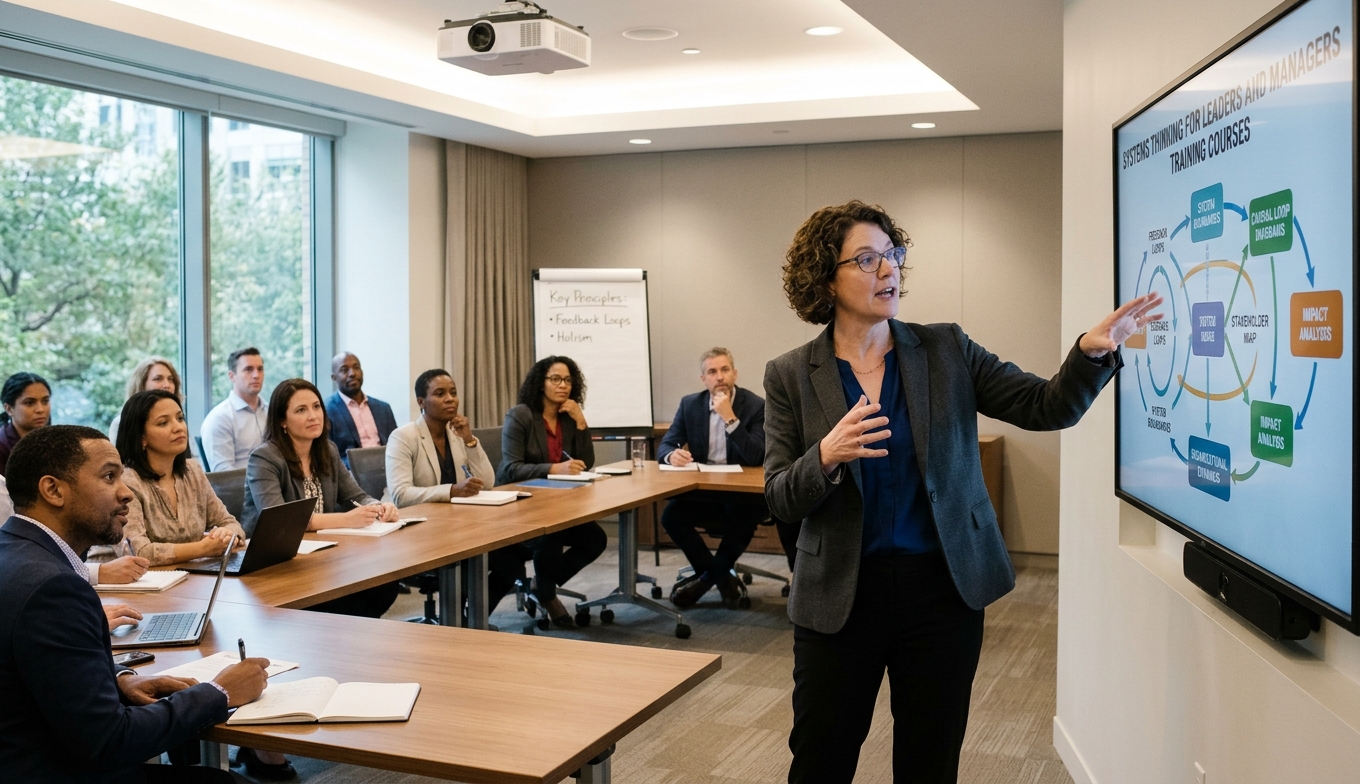
The Geneva Institute of Business Management offers the Systems Thinking for Leaders and Managers Training Courses as part of its Leadership and Management Training Courses category. This professional development programme is designed to strengthen leadership capabilities by helping managers understand how different organisational systems, business functions, people, processes, and strategic priorities interact to influence overall performance. It provides a structured approach to analysing complex business environments, identifying underlying challenges, and making decisions that support sustainable organisational success.
Modern organisations operate within increasingly interconnected business environments. Changes in one department, operational process, management decision, or external market condition can create consequences across multiple areas of an organisation. Traditional management approaches often focus on individual problems without examining the wider structures and relationships that contribute to them. Systems Thinking provides leaders with a broader perspective, enabling them to understand organisational interconnectedness and recognise how individual activities contribute to collective business outcomes.
The Systems Thinking for Leaders and Managers Training Courses focus on developing the ability to examine organisations as interconnected systems rather than isolated departments or independent processes. Participants explore how organisational structures, workflows, communication channels, leadership practices, resources, and performance measures influence one another. This perspective enables managers to identify recurring operational problems, understand the relationships behind business challenges, and develop solutions that address underlying causes rather than temporary symptoms.
A central element of the programme is the application of systems thinking to strategic analysis and organisational decision-making. Leaders must frequently make decisions involving competing priorities, limited resources, changing market conditions, and uncertain outcomes. Understanding the wider consequences of these decisions is essential for maintaining organisational stability and achieving long-term objectives. Systems Thinking helps managers evaluate multiple factors simultaneously, anticipate possible consequences, and assess how strategic choices influence different areas of business performance.
The programme also addresses organisational complexity and the challenges associated with managing interconnected business operations. As organisations expand, introduce new technologies, enter different markets, and develop more sophisticated operating structures, their internal systems become increasingly dependent on one another. Managers need the ability to recognise patterns, evaluate relationships, understand feedback mechanisms, and respond effectively to changes that affect the wider organisation.
Through practical management scenarios and business-focused applications, the Geneva Institute of Business Management helps participants develop a systematic approach to leadership challenges. The programme examines how systems thinking supports organisational alignment, cross-functional collaboration, resource allocation, risk assessment, strategic planning, and continuous improvement. It also explores the relationship between leadership behaviour and organisational systems, highlighting how management decisions can influence employee performance, organisational culture, operational efficiency, and business resilience.
Another important focus is the integration of systems thinking into everyday management responsibilities. Leaders must understand how decisions made at different organisational levels contribute to wider business objectives. By developing a systems-oriented management approach, they can improve coordination between departments, reduce operational conflicts, identify opportunities for improvement, and strengthen the organisation's ability to respond to complex challenges.
The Systems Thinking for Leaders and Managers Training Courses are particularly relevant to organisations seeking stronger strategic leadership, improved management coordination, and more effective approaches to organisational transformation. The programme supports professionals who want to move beyond isolated problem-solving and develop a comprehensive understanding of the forces shaping organisational performance.
By the end of the programme, participants will have a stronger ability to interpret complex organisational situations, evaluate interconnected business challenges, and make informed management decisions. They will be better equipped to recognise systemic risks, assess the broader implications of organisational changes, and establish management strategies that contribute to sustainable performance and long-term business development.
Objectives
The Systems Thinking for Leaders and Managers Training Courses aim to strengthen the ability of managers and senior professionals to understand organisational complexity, analyse interconnected business challenges, and apply systems thinking to strategic leadership and management decisions.
The key objectives include:
-
Develop a comprehensive understanding of systems thinking and its relevance to modern organisational leadership and management.
-
Strengthen the ability to examine organisations as interconnected systems involving people, processes, departments, technology, resources, and external stakeholders.
-
Improve awareness of organisational interconnectedness and how changes in one business area influence performance across other functions.
-
Develop strategic analysis capabilities for evaluating complex management challenges and identifying relationships between contributing factors.
-
Strengthen decision-making processes by considering immediate outcomes alongside long-term organisational consequences.
-
Enable managers to distinguish between underlying systemic problems and their visible operational symptoms.
-
Improve the ability to identify patterns, dependencies, feedback mechanisms, and recurring challenges within organisational systems.
-
Develop a structured approach to analysing organisational complexity and managing situations involving multiple stakeholders and competing priorities.
-
Strengthen cross-functional coordination by understanding how different departments contribute to shared organisational objectives.
-
Improve strategic planning through a broader assessment of internal capabilities, external influences, operational dependencies, and organisational priorities.
-
Enhance risk management by identifying systemic vulnerabilities and understanding how risks can spread across interconnected business functions.
-
Develop the ability to assess the organisational impact of leadership decisions, structural changes, and operational improvements.
-
Strengthen organisational adaptability by recognising emerging challenges and responding to changing business conditions.
-
Improve resource allocation through an understanding of organisational priorities, dependencies, and performance relationships.
-
Support continuous improvement by identifying opportunities to improve entire processes rather than focusing on isolated operational activities.
-
Encourage collaborative leadership approaches that integrate different perspectives into complex problem-solving and management decisions.
-
Strengthen the connection between organisational strategy, management responsibilities, operational execution, and measurable business outcomes.
-
Enable leaders to develop sustainable solutions that improve organisational effectiveness, resilience, and long-term performance.
Target Audience
The Systems Thinking for Leaders and Managers Training Courses are designed for professionals responsible for organisational leadership, strategic planning, management decisions, operational coordination, and business performance. The programme is particularly suitable for individuals who manage interconnected functions and need to understand how decisions in one area affect the wider organisation.
The target audience includes:
Senior Executives and Business Leaders
Chief executives, managing directors, executive directors, and senior business leaders seeking to improve strategic oversight and understand the relationships between organisational functions. The programme supports their ability to evaluate complex business situations, establish strategic priorities, and make decisions that consider the wider organisational environment.
Department Heads and Functional Managers
Department heads and functional managers responsible for coordinating teams, managing resources, and achieving departmental objectives. They can strengthen their understanding of how departmental performance influences other organisational functions and how cross-functional dependencies affect business outcomes.
Strategic Planning Professionals
Strategic planning managers, corporate strategy specialists, and business planning professionals involved in organisational development and long-term planning. The programme helps them incorporate systems thinking into strategic analysis, evaluate organisational relationships, and assess the wider implications of strategic initiatives.
Operations and General Managers
Operations managers, general managers, and business unit leaders responsible for organisational processes, operational efficiency, and service delivery. They can develop a broader perspective on operational dependencies, recurring performance challenges, and opportunities for integrated process improvement.
Project and Programme Managers
Project managers, programme directors, and transformation professionals responsible for delivering initiatives across multiple departments. The programme strengthens their ability to understand project dependencies, evaluate organisational impacts, and manage interconnected risks and responsibilities.
Human Resources and Organisational Development Professionals
HR directors, organisational development managers, and talent management professionals interested in understanding how workforce structures, organisational culture, employee engagement, and management practices influence overall performance.
Change Management and Transformation Leaders
Professionals responsible for organisational restructuring, business transformation, process redesign, and strategic change initiatives. They can benefit from understanding how organisational systems respond to change and how adjustments in one area influence other business activities.
Business Analysts and Management Consultants
Business analysts, management consultants, and organisational improvement specialists who evaluate business operations and recommend management solutions. The programme provides a systems-oriented perspective for identifying underlying challenges and assessing relationships between organisational factors.
Risk Management and Governance Professionals
Risk managers, compliance professionals, and governance specialists responsible for identifying organisational vulnerabilities and maintaining effective management controls. Systems thinking supports their ability to recognise interconnected risks and evaluate their potential consequences across business functions.
Emerging Leaders and Future Managers
Professionals preparing for senior management responsibilities who want to strengthen their strategic perspective, develop structured problem-solving capabilities, and understand the complexity of modern organisational environments.
Modules
Module 1: Fundamentals of Systems Thinking in Leadership and Management
This module establishes the foundations of systems thinking and examines its relevance to modern business leadership. Participants explore the difference between traditional linear management approaches and systems-oriented thinking. The focus is on understanding organisations as interconnected structures in which individual components contribute to broader organisational outcomes.
Key areas include:
-
Introduction to systems thinking and its management applications.
-
Principles of systems theory in organisational environments.
-
Linear thinking versus systems thinking in management.
-
Organisational systems, structures, and relationships.
-
Understanding interconnectedness across business functions.
-
The relationship between organisational components and overall performance.
-
Systems-oriented approaches to leadership and management challenges.
Module 2: Understanding Organisational Systems and Interconnectedness
This module examines how organisational systems operate through relationships between people, departments, processes, technologies, and resources. Participants explore how decisions and activities within one business function influence other areas of the organisation.
The emphasis is on developing a comprehensive understanding of organisational interconnectedness and identifying the dependencies that affect operational and strategic performance.
Key areas include:
-
Components of organisational systems.
-
Relationships between departments and business functions.
-
Internal organisational dependencies and interactions.
-
Communication flows and information networks.
-
Organisational structures and management relationships.
-
Cross-functional coordination and collaboration.
-
Identifying gaps between departmental objectives and organisational priorities.
-
Understanding how local decisions influence overall business performance.
Module 3: Managing Complexity in Modern Organisations
Organisations face challenges involving multiple stakeholders, competing priorities, changing environments, and interconnected operational activities. This module explores how leaders can understand and manage complexity without reducing complicated situations to oversimplified problems.
Participants examine the factors that contribute to organisational complexity and develop approaches for analysing situations involving multiple relationships and uncertain outcomes.
Key areas include:
-
Sources and characteristics of organisational complexity.
-
Complex business environments and management challenges.
-
Interdependencies between organisational activities.
-
Managing uncertainty in strategic and operational situations.
-
Recognising patterns within complex organisational environments.
-
Evaluating competing priorities and organisational constraints.
-
Understanding unintended consequences of management decisions.
-
Developing adaptive approaches to complex leadership challenges.
Module 4: Systems Mapping and Organisational Analysis
This module introduces systems mapping as a practical approach to understanding organisational structures, relationships, and dependencies. Participants explore how visual representations and analytical techniques can help managers identify the connections between different elements of a business system.
The module focuses on examining organisational challenges from multiple perspectives and identifying areas where improvements can generate wider benefits.
Key areas include:
-
Introduction to systems mapping techniques.
-
Identifying organisational components and stakeholders.
-
Mapping relationships between business activities.
-
Understanding process dependencies and information flows.
-
Identifying organisational bottlenecks and structural weaknesses.
-
Analysing relationships between causes and consequences.
-
Using systems maps to support management discussions.
-
Applying organisational analysis to business improvement initiatives.
Module 5: Feedback Loops, Patterns, and System Behaviour
This module examines how feedback mechanisms influence organisational behaviour and performance over time. Participants explore reinforcing and balancing feedback loops and understand how organisational decisions, employee behaviour, operational processes, and management controls interact.
The focus is on recognising recurring patterns and understanding why certain organisational problems continue despite repeated corrective actions.
Key areas include:
-
Understanding feedback loops in organisational systems.
-
Reinforcing and balancing feedback mechanisms.
-
Identifying recurring organisational performance patterns.
-
Understanding delays between management decisions and outcomes.
-
Examining the relationship between actions and consequences.
-
Recognising unintended behavioural responses to management interventions.
-
Using feedback analysis to improve organisational effectiveness.
-
Developing management responses based on systemic behaviour.
Module 6: Strategic Analysis Through Systems Thinking
Strategic analysis requires leaders to understand the wider business environment and evaluate how different organisational factors influence strategic outcomes. This module explores how systems thinking can strengthen strategic assessment by considering internal capabilities, external influences, market conditions, organisational dependencies, and long-term objectives.
Participants develop a broader perspective on strategic planning and learn to assess the implications of decisions across interconnected business areas.
Key areas include:
-
Systems thinking in corporate strategic analysis.
-
Evaluating internal and external business environments.
-
Identifying strategic dependencies and organisational constraints.
-
Analysing relationships between business objectives and operational capabilities.
-
Understanding the wider impact of strategic initiatives.
-
Evaluating short-term priorities against long-term objectives.
-
Recognising strategic risks and emerging opportunities.
-
Integrating systems analysis into organisational planning.
Module 7: Systems Thinking and Effective Decision-Making
This module focuses on strengthening management decision-making through a systematic evaluation of organisational relationships and potential consequences. Participants examine how decisions affect different departments, employees, stakeholders, and operational processes.
The emphasis is on developing decision-making approaches that account for complexity, interconnectedness, uncertainty, and long-term organisational performance.
Key areas include:
-
Systems-based decision-making frameworks.
-
Evaluating decisions from multiple organisational perspectives.
-
Identifying direct and indirect consequences of management actions.
-
Balancing immediate business requirements with long-term outcomes.
-
Assessing trade-offs between competing organisational priorities.
-
Integrating evidence and stakeholder perspectives into decisions.
-
Reducing unintended consequences of management interventions.
-
Improving strategic judgement in complex business environments.
Module 8: Root Cause Analysis and Systemic Problem-Solving
Many organisational challenges are symptoms of deeper structural or operational weaknesses. This module examines how systems thinking supports root cause analysis and helps managers identify the underlying conditions responsible for recurring problems.
Participants explore methods for moving beyond temporary corrective measures and developing solutions that address the broader organisational system.
Key areas include:
-
Identifying symptoms versus underlying systemic problems.
-
Root cause analysis in organisational environments.
-
Examining relationships between processes and performance failures.
-
Identifying structural and operational causes of recurring challenges.
-
Understanding how management practices influence organisational problems.
-
Evaluating alternative solutions through systems analysis.
-
Developing integrated problem-solving approaches.
-
Assessing the long-term effectiveness of management interventions.
Module 9: Systems Thinking for Organisational Change and Transformation
Organisational change affects multiple interconnected areas, including structures, responsibilities, processes, technology, and employee behaviour. This module explores how systems thinking can help leaders understand the wider implications of transformation initiatives and manage change more effectively.
Participants examine how changes in one part of an organisation influence other functions and how leadership can maintain alignment throughout transformation.
Key areas include:
-
Understanding organisations as dynamic systems.
-
Systems thinking in organisational transformation.
-
Analysing the wider impact of structural and operational changes.
-
Managing dependencies during transformation initiatives.
-
Understanding employee and stakeholder responses to change.
-
Aligning organisational systems with strategic objectives.
-
Identifying resistance and unintended consequences.
-
Strengthening organisational adaptability and resilience.
Module 10: Cross-Functional Leadership and Organisational Alignment
Effective leadership requires collaboration across organisational boundaries. This module explores how systems thinking supports cross-functional leadership by helping managers understand shared responsibilities, interdepartmental dependencies, and collective organisational objectives.
Participants examine approaches for reducing departmental barriers and improving coordination between different business functions.
Key areas include:
-
Systems thinking in cross-functional management.
-
Aligning departmental goals with organisational strategy.
-
Improving communication across organisational boundaries.
-
Managing competing departmental priorities.
-
Strengthening stakeholder relationships and collaboration.
-
Understanding shared accountability and collective performance.
-
Improving coordination between leadership and operational teams.
-
Building an integrated approach to organisational management.
Module 11: Systems Thinking in Risk Management and Organisational Resilience
Organisational risks frequently extend beyond individual departments or processes. A disruption in one area can affect several interconnected functions, creating wider operational and strategic consequences. This module examines how systems thinking strengthens organisational risk management and supports business resilience.
Participants explore how to identify systemic vulnerabilities, understand risk dependencies, and develop management responses that consider the organisation as a whole.
Key areas include:
-
Understanding systemic risks in organisational environments.
-
Identifying interconnected operational and strategic vulnerabilities.
-
Analysing risk relationships and potential consequences.
-
Evaluating the wider impact of organisational disruptions.
-
Strengthening risk awareness across departments.
-
Integrating systems thinking into risk assessment.
-
Developing organisational resilience strategies.
-
Supporting business continuity and long-term stability.
Module 12: Continuous Improvement and Sustainable Organisational Performance
The final module focuses on applying systems thinking to organisational improvement and sustainable performance. Participants examine how interconnected business processes can be evaluated and improved to achieve consistent operational and strategic results.
The emphasis is on developing an integrated management approach that connects organisational objectives, performance indicators, resources, and improvement initiatives.
Key areas include:
-
Systems thinking in continuous organisational improvement.
-
Identifying opportunities for integrated process improvement.
-
Understanding relationships between organisational performance indicators.
-
Evaluating the wider impact of improvement initiatives.
-
Aligning resources with organisational priorities.
-
Developing sustainable performance management approaches.
-
Monitoring systemic changes and organisational outcomes.
-
Embedding systems thinking into leadership practices and management culture.
FAQs
1. What is Systems Thinking in leadership and management?
Systems Thinking is a management approach that examines an organisation as an interconnected system rather than a collection of independent departments. It helps leaders understand how people, processes, resources, and decisions influence one another and affect overall organisational performance.
2. Why is Systems Thinking important for leaders and managers?
Systems Thinking enables leaders to understand organisational complexity, identify underlying business problems, and evaluate the wider consequences of management decisions. It supports strategic analysis, cross-functional collaboration, effective decision-making, and sustainable organisational performance.
3. What topics are covered in the Systems Thinking for Leaders and Managers Training Courses?
The programme covers systems thinking fundamentals, organisational interconnectedness, complexity management, systems mapping, feedback loops, strategic analysis, decision-making, root cause analysis, organisational transformation, cross-functional leadership, risk management, and continuous improvement.
4. Who should attend the Systems Thinking for Leaders and Managers Training Courses?
The programme suits senior executives, department heads, general managers, strategic planning professionals, operations managers, project managers, business analysts, management consultants, and organisational development professionals. It is also relevant to emerging leaders preparing for broader management responsibilities.
5. How does Systems Thinking improve organisational decision-making?
Systems Thinking improves organisational decision-making by helping managers evaluate relationships between different business functions and consider both immediate and long-term consequences. It enables leaders to identify potential risks, understand organisational dependencies, assess alternative solutions, and make decisions that support wider business objectives.
Venues and dates
This programme runs every month in the following cities. Select a venue to register.
 Geneva
Switzerland
 Zurich
Switzerland
Basel
Switzerland
 London
UK
 Manchester
UK
 Oxford
UK
 Madrid
Spain
 Barcelona
Spain
 Paris
France
 Rome
Italy
 Vienna
Austria
Oslo
Norway
 Athens
Greece
 Copenhagen
Denmark
 Berlin
Germany
 Munich
Germany
 New York
USA
 Washington
USA
 Dubai
UAE
 Istanbul
Turkey
 Amsterdam
Netherlands
 Brussels
Belgium
 Lisbon
Portugal
 Malaga
Spain
 Milan
Italy
 Dusseldorf
Germany
 Prague
Czech Republic
 Budapest
Hungary
 Stockholm
Sweden
 Sheffield
UK
 Bangor
UK
 Ankara
Turkey
 Abu Dhabi
UAE
 Doha
Qatar
 Riyadh
Saudi Arabia
 Jeddah
Saudi Arabia
 Dammam
Saudi Arabia
 Muscat
Oman
 Amman
Jordan
 Cairo
Egypt
 Sharm El Sheikh
Egypt
 Casablanca
Morocco
 Marrakesh
Morocco
 Agadir
Morocco
 Tangier
Morocco
 Tunis
Tunisia
 Kuala Lumpur
Malaysia
 Singapore
 Jakarta
Indonesia
 Phuket
Thailand
 Tokyo
Japan
 Beijing
China
 Los Angeles
USA
 California
USA
 Toronto
Canada